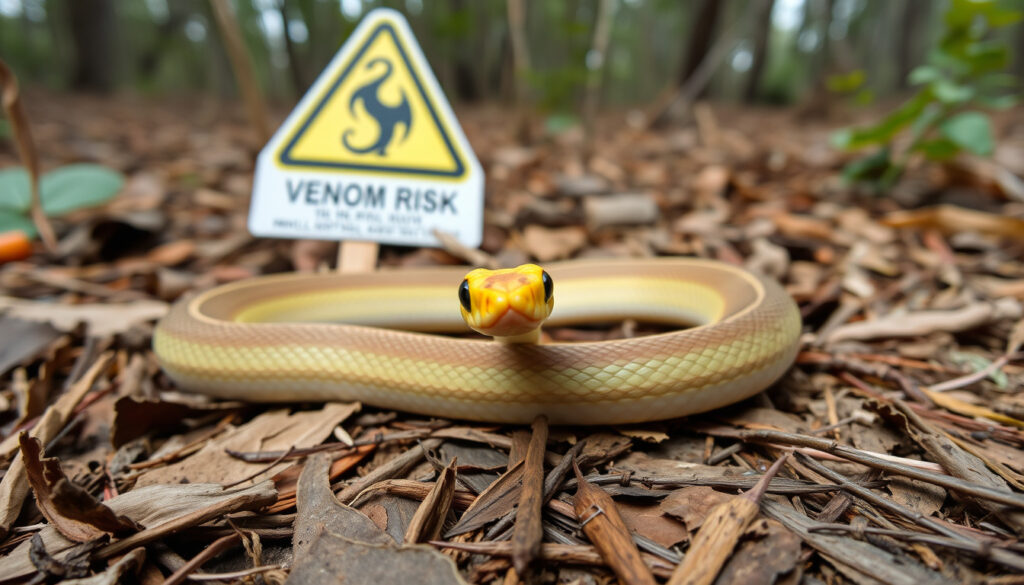
Yellow Faced Whip Snake: Venom, Bite Symptoms & Safety
Few snakes spark as much confusion as the yellow-faced whip snake. Often mistaken for its far deadlier relative, the Eastern brown snake, this slender Australian elapid is actually one of the less threatening members of its family.
Average length: 80 cm (max 1 m) (Australian Museum) ·
Venom potency: Mildly venomous; not considered life-threatening (CPR First Aid Australia (citing Australian Museum)) ·
Distribution: Eastern Australia, from Queensland to Victoria (Australian Museum) ·
Family: Elapidae (includes many dangerous snakes) (Australian Museum)
Quick snapshot
- Yellow face stripe (CPR First Aid Australia)
- Slender body up to 1 m (Australian Museum)
- Olive to brown coloration (Australian Museum)
- Mildly venomous (CPR First Aid Australia (citing Australian Museum))
- Bites cause pain and swelling (CPR First Aid Australia)
- Not considered life-threatening (CPR First Aid Australia (citing Australian Museum))
- Woodlands, grasslands (Australian Museum)
- Eastern Australia (Australian Museum)
- Diurnal and active on ground (Australian Museum)
- Shy and fast-moving (CPR First Aid Australia)
- Non-aggressive unless provoked (CPR First Aid Australia)
- Often confused with Eastern brown snake (Australian Museum)
Four key specs, one pattern: the yellow-faced whip snake is built for speed, not confrontation. Its slender frame and mild venom align with a defensive rather than predatory strategy.
| Trait | Value | Source |
|---|---|---|
| Scientific name | Demansia psammophis | Australian Museum |
| Average length | 80 cm (max 1 m) | Australian Museum |
| Venom type | Neurotoxic and cytotoxic (mild) | CPR First Aid Australia (citing Australian Museum) |
| Conservation status | Least Concern | Wikipedia |
| Geographic range | Eastern Australia (QLD, NSW, VIC, SA) | Australian Museum |
How venomous is a yellow-faced whip snake?
Understanding venom potency
The yellow-faced whip snake carries venom, but it’s mild compared to other elapids. According to CPR First Aid Australia (citing the Australian Museum), the snake is venomous but not considered deadly to humans. Its venom contains both neurotoxic and cytotoxic components, but the dose delivered in a bite is typically low.
Medical significance of bites
A bite from a yellow-faced whip snake can be extremely painful, with much local swelling, as described by an Australian Museum reptile expert. However, systemic envenomation is rare. Wikipedia (citing herpetological sources) notes that bites rarely require antivenom and are treated supportively. Still, any elapid bite warrants medical attention because the line between “mild” and “dangerous” can blur without professional assessment.
For a gardener or hiker in eastern Australia, the chance of a serious reaction from this snake is low, but the risk of secondary infection or an allergic response means you should never shrug off a bite.
Is a yellow-faced whip snake poisonous?
Venomous vs poisonous distinction
Biologically, “poisonous” refers to toxins that harm when ingested or touched, while “venomous” means toxins are injected. The yellow-faced whip snake is venomous, not poisonous. It delivers venom through fangs, and the venom is not dangerous if the snake is handled safely after death. This distinction matters because first aid for venom injection differs from poison exposure.
Yellow-faced whip snake venom type
The venom is classified as mild. CPR First Aid Australia (citing the Australian Museum) states that while the bite can be painful, the venom is not considered a threat to life.
What are the symptoms of a yellow-faced whip snake bite?
Immediate symptoms
According to CPR First Aid Australia, immediate intense pain, local swelling, and redness are typical. Some victims report nausea or headache. The pain can be severe, as noted by an Australian Museum reptile expert.
First aid steps
The recommended response follows the DRSABCD action plan. CPR First Aid Australia advises: apply a pressure immobilisation bandage starting from the bite site upwards, splint the limb, mark the bite location, and call emergency services. Do not wash the wound, cut it, suck out venom, or use a tourniquet.
- Call 000 (Australia) or local emergency number
- Keep the victim calm and still
- Apply pressure immobilisation bandage
- Splint the affected limb
- Mark the bite site on the bandage
When to seek medical help
Any elapid bite should be assessed in a hospital. The World Health Organization recommends early antivenom administration within 4 hours for severe envenomations, although whip snake bites rarely progress that far. Position the victim on their left side during transport to prevent airway obstruction.
Pressure immobilisation is counterintuitive for many people who want to “let the venom out.” Yet it’s the only proven method to slow venom spread for all Australian snakebites, as confirmed by Healthdirect Australia.
How does a yellow-faced whip snake compare to an Eastern brown snake?
Venom potency comparison
The Eastern brown snake (Pseudonaja textilis) is in a different league. Healthdirect Australia states it is responsible for the majority of snakebite deaths in Australia due to its highly neurotoxic and coagulopathic venom. The yellow-faced whip snake’s venom is mild in comparison – a difference that can be fatal if misidentified.
Appearance differences
Size is a quick tell. The Eastern brown snake can reach 2.4 m, while the whip snake maxes out at 1 m. The whip snake has a distinctive yellow band across its face, whereas the Eastern brown has a uniform brown colour, sometimes with a darker head, as described by the Australian Museum.
Behavior and habitat
Both snakes inhabit overlapping ranges in eastern Australia. The Australian Reptile Online Database confirms their distribution overlap. The whip snake is shy and quick to flee; the Eastern brown is more defensive and can be aggressive. This behavioural difference is a key reason why the whip snake is less dangerous.
Three contrasts, one pattern: misidentification risks over- or under-treating a bite because the snakes look similar from a distance.
| Trait | Yellow-faced Whip Snake | Eastern Brown Snake |
|---|---|---|
| Max length | 1 m | 2.4 m |
| Venom potency | Mild – not life-threatening | Highly dangerous – responsible for most Australian snakebite deaths |
| Face coloration | Distinctive yellow stripe | Uniform brown, sometimes darker head |
| Behavior | Shy, fast, non-aggressive | Defensive, can be aggressive |
| Antivenom required | Rarely | Often multiple vials |
The implication: if you see a snake in eastern Australia, look for the yellow face stripe. A quick identification can calm nerves – and guide correct first aid.
Why is it called a whip snake?
Origin of the common name
The name comes from the snake’s remarkable speed and slender body. Early settlers noted that it moved with a whip-like cracking motion across the ground. According to the Australian Museum, the common name refers to its fast, whip-like movement. For more information on identifying this snake, you can explore the Secrets of the Silent Witch.
Snake movement description
The snake’s body is long and thin, allowing rapid acceleration. It can disappear into grass in a split second, which reinforces the whip metaphor. This speed, combined with its shy nature, means it typically escapes rather than confronts.
What we know and what remains unclear
Confirmed facts
- Yellow-faced whip snake is mildly venomous (CPR First Aid Australia).
- Bites are painful but rarely dangerous to healthy adults (CPR First Aid Australia (citing Australian Museum)).
- It is a species of elapid snake found in eastern Australia (Australian Museum).
What’s unclear
- Exact number of reported envenomations per year is unknown.
- Long-term effects of secondary infection after a whip snake bite are not well documented.
Expert perspectives on the bite
A bite could be extremely painful, with much local swelling.
— Australian Museum reptile expert, as quoted by CPR First Aid Australia
Potentially dangerous especially with children involved.
— Local snake catcher, as quoted by CPR First Aid Australia
These two viewpoints capture the range: an otherwise mild snake that can still pose a risk to vulnerable individuals. The takeaway for families in snake-prone areas is to treat every whip snake bite as a medical event, even if the odds are in your favour.
marsdenvet.com.au, my.clevelandclinic.org, pmc.ncbi.nlm.nih.gov, animalemergencyservice.com.au
For example, the yellow-faced whip snake is often confused with the more dangerous baby brown snake, so consulting a guide on baby brown snake identification can help with accurate identification.
Frequently asked questions
Which snake has killed the most humans?
The saw-scaled viper (Echis carinatus) is responsible for more human deaths globally than any other snake, according to the World Health Organization. In Australia, the Eastern brown snake causes the most fatalities.
Which snake is called the silent killer?
The term often refers to the coastal taipan (Oxyuranus scutellatus) because its bite can be painless while the venom rapidly causes paralysis and internal bleeding. The yellow-faced whip snake is not considered a silent killer.
What animal is not afraid of snakes?
Several mammals, including the honey badger (Mellivora capensis) and the mongoose, are known to actively hunt snakes. In Australia, the monitor lizard (goanna) frequently preys on snakes, including whip snakes.
What liquids do snakes hate?
Strong smells like ammonia and vinegar may deter snakes, but there is no scientific consensus. Avoiding habitat (long grass, woodpiles) is more effective than repellents.
What is Europe’s deadliest snake?
The European adder (Vipera berus) is the most dangerous, though fatalities are rare. Its venom can cause severe reactions in children and pets.
How can I identify a yellow-faced whip snake?
Look for a slender body under 1 m, olive to brown colour, and a bright yellow stripe running from the nostril across the eye and down the side of the head. This stripe is the most reliable field mark, as confirmed by the Australian Museum.
What should I do if I see a yellow-faced whip snake?
Stay calm, keep a distance of at least 2 metres, and let the snake move away. It will almost certainly flee. Do not attempt to capture or kill it – most snakebites occur during human provocation.
For the homeowner in rural New South Wales, the presence of a yellow-faced whip snake is rarely a crisis. The real risk lies in misidentifying it and ignoring a dangerous bite from something like an Eastern brown. The lesson is clear: learn to spot that yellow stripe, respect every snake encounter, and have a first aid plan ready – because in the bush, hesitation costs time, and time can cost a life.
More related posts
 Farmer Wants a Wife 2025 Cast: Members, Updates & Couples
 Free Rego Check VIC: VicRoads & Service Victoria Guide
 Reggie Kray: Life, Crimes, and Notorious Legacy
 Chloe Pink: Marriage to Toby Pink, Online Abuse, and Career
 Mark Goldbridge: Real Name, Net Worth & YouTube Channel
 Billie Eilish Met Gala – Outfits 2021-2023
 Cigarettes After Sex – Band History Members Albums Tour
 Saif Ali Khan: Attack, Divorce, Religion & Wealth 2025
