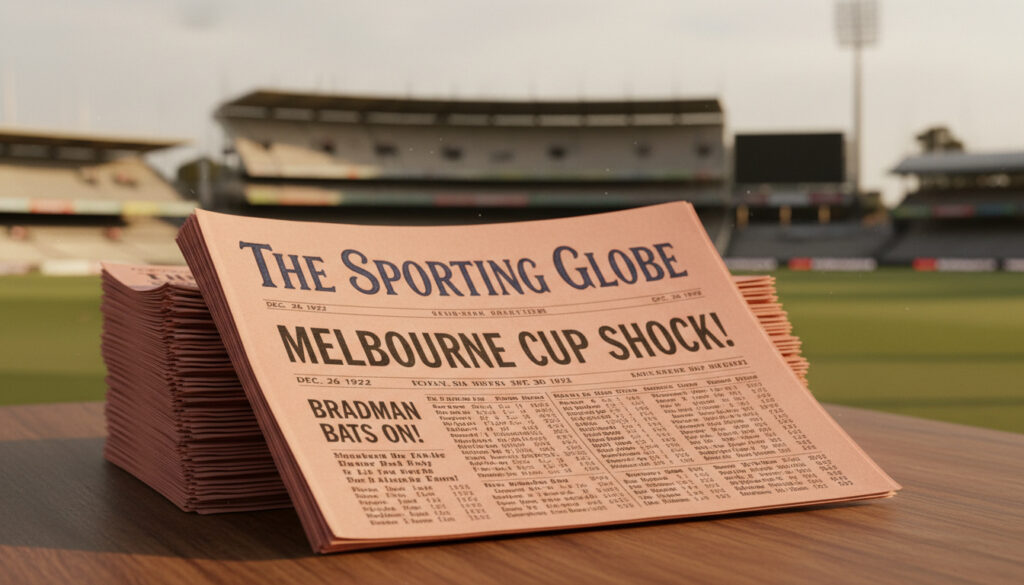
The Sporting Globe – Melbourne’s Pink Sports Paper 1922-1996
The Sporting Globe emerged on 22 July 1922 as Melbourne’s definitive sports newspaper, distinguishing itself immediately through distinctive pink paper and a singular focus on athletic competition. Published by The Herald and Weekly Times from its inception through its closure, the tabloid operated from the corner of Flinders and Russell streets, serving as an essential information source for Victorian sports enthusiasts before the dominance of broadcast media.
For 74 years, the publication documented Melbourne’s sporting obsessions, particularly Australian Rules Football, before economic pressures and technological shifts forced its cessation on 2 September 1996. Its archives now represent a critical primary resource for understanding Australian sporting culture during the twentieth century.
What Was The Sporting Globe?
The Sporting Globe functioned as a specialized sporting publication that occupied a unique niche in Australian print media. Established by The Herald and Weekly Times, the newspaper maintained consistent ownership throughout its existence, with Keith Duncan MacPherson serving as publisher during its later decades.
Key Characteristics
- Printed on distinctive pink paper that made it instantly recognizable at newsstands
- Maintained tabloid format throughout its entire 74-year publication history
- Operated as a semi-weekly publication for 57 years before converting to weekly distribution
- Carried ISSN 1030-0317 and published exclusively in English
- Printed physically at the corner of Flinders and Russell streets in Melbourne’s CBD
- Priced at 2 pence for initial Saturday editions, rising to 3 pence for the expanded Wednesday format
- Served as the flagship sports title for The Herald and Weekly Times media group
| Fact | Details |
|---|---|
| Publisher | The Herald and Weekly Times |
| Founded | 22 July 1922 |
| Format | Tabloid |
| Frequency | Semi-weekly (1922-1979), Weekly (1979-1996) |
| Price at Launch | 2 pence (Saturday), 3 pence (Wednesday) |
| Final Issue | 2 September 1996 |
| ISSN | 1030-0317 |
| Language | English |
| Print Location | Corner of Flinders and Russell streets, Melbourne |
| Notable Leadership | Keith Duncan MacPherson (later years) |
When and How Long Was The Sporting Globe Published?
The Sporting Globe maintained continuous publication for 74 years, though its frequency and format evolved significantly during this period. The newspaper’s temporal span divides sharply into two distinct eras corresponding to changing media consumption patterns and economic realities.
The Semi-Weekly Era (1922-1979)
Initially, the paper appeared only on Saturday evenings, priced at 2 pence. Within weeks of its debut, however, a Wednesday afternoon edition entered circulation on 16 August 1922, commanding 3 pence for the larger format. This semi-weekly schedule persisted for 57 years, establishing the publication as a fixture of mid-week and weekend sporting discourse.
The Weekly Transition (1979-1996)
In 1979, management discontinued the Saturday evening edition, converting operations exclusively to the Wednesday format. This reduction marked a significant contraction in the paper’s operational scope, reflecting broader challenges facing print media. The final Wednesday edition appeared on 2 September 1996, terminating the publication’s seven-decade run.
What Sports Did The Sporting Globe Cover?
While the publication briefly experimented with broader entertainment coverage, sporting content dominated its pages throughout its existence. The newspaper’s editorial focus centered particularly on Australian Rules Football, capturing the zeitgeist of Melbourne’s sporting obsession during the pre-television era.
Australian Rules Football Dominance
The Saturday evening edition achieved particular cultural resonance through its timing: released one to two hours after the completion of afternoon Victorian Football League fixtures, it provided match results and analytical reports to crowds dispersing from grounds. This distribution model proved essential before 1956, when television broadcasting did not yet exist in Australia.
Contemporary accounts described the scene surrounding the paper’s distribution as an “amazing spectacle of thousands of Melburnians turning out each week to follow their team,” illustrating the newspaper’s role as a communal information hub for football supporters.
Brief Diversification
During its initial months, when the Wednesday edition launched in August 1922, the paper temporarily expanded its subtitle to “A Journal of Sport, the Stage and the Screen.” This multimedia approach proved short-lived; by 1924, the publication reverted to exclusive sports coverage, recognizing that specialization provided its strongest market position against general-interest competitors.
Why Did The Sporting Globe Close?
The cessation of publication in 1996 resulted from cumulative pressures that had already forced significant operational changes in 1979. Multiple structural shifts in Australian society during the mid-to-late twentieth century eroded the newspaper’s readership base and economic viability.
Technological Disruption
The introduction and expansion of television coverage fundamentally altered how Australians consumed sports information. Once viewers could watch events unfold in real-time or access immediate broadcast summaries, the demand for printed match reports delivered hours after games concluded diminished precipitously.
Television broadcasting began in Australia in 1956, providing immediate visual access to sporting events and progressively diminishing the need for post-match newspaper reports that had constituted The Sporting Globe’s core value proposition.
Transportation Shifts
Changing transportation preferences significantly impacted distribution efficacy. As private automobile ownership replaced public transport for attending football matches, the concentrated crowds at train stations and tram stops—traditional distribution points for the Saturday evening edition—dissipated. Readers no longer gathered in central locations where newspaper vendors could reach them efficiently immediately after games.
The shift from public transport to private cars fragmented post-match crowds, undermining the distribution model that relied on reaching concentrated groups of fans at transit hubs immediately following Victorian Football League games.
Archival Preservation
Despite the closure, significant archival holdings ensure the paper’s content remains accessible to researchers. The National Library of Australia maintains digital access to issues from 22 July 1922 through 29 December 1954 via Trove. Physical holdings include the complete run through 1988, encompassing 7,429 issues.
While Trove provides comprehensive digital access for the 1922-1954 period, later editions require physical consultation at the National Library of Australia or the State Library of Victoria, with some title variations cataloged as “Weekend Sporting Globe” and “Midweek Sporting Globe.” The Sporting Globe emerged during a pivotal moment in Australian media history, launching in the same year—1922—as the Sun News-Pictorial, another major Saturday evening publication, and you can find a summary of The Art of War at The Art of War summary.
What Was The Publication Timeline of The Sporting Globe?
- : First Saturday evening edition published by The Herald and Weekly Times on distinctive pink paper
- : Wednesday afternoon edition introduced, expanding to semi-weekly publication
- : Publication reverted to exclusive sports coverage, discontinuing stage and screen content
- : Television introduced in Australia, beginning competitive pressure on post-match print reporting
- : Saturday edition discontinued; publication reduced to weekly Wednesday format only
- : Final Wednesday edition published, concluding 74 years of continuous operation
What Facts Are Verified About The Sporting Globe’s History?
| Established Information | Uncertain or Unverified Details |
|---|---|
| Founded 22 July 1922 by The Herald and Weekly Times | Peak circulation figures during the 1950s-1970s high-water mark |
| Final issue dated 2 September 1996 | Exact appointment date of Keith Duncan MacPherson as publisher |
| Published at Flinders and Russell streets, Melbourne | Specific financial losses triggering the 1979 format reduction |
| ISSN 1030-0317 assigned | Complete contributor lists for early editorial staff |
| Pink paper format maintained throughout | Reasons for the specific 1996 closure timing versus earlier years |
| Semi-weekly 1922-1979, weekly 1979-1996 | Comprehensive advertising revenue figures by decade |
What Was The Historical Context of The Sporting Globe?
The Sporting Globe emerged during a pivotal moment in Australian media history, launching in the same year—1922—as the Sun News-Pictorial, another major Saturday evening publication. Both titles strategically timed their distribution to coincide with football fixtures, recognizing the commercial potential of post-match crowds. Original copies now reside in state library collections, preserving this cultural artifact of Melbourne’s sporting golden age.
The paper succeeded earlier Victorian sporting journalism traditions dating to Bell’s Life in Victoria and Sporting Chronicle (1857), while competing directly with contemporaries like the Sporting Judge (1892-1965) and sports sections within general newspapers such as the Australasian and the Argus. Modern sports coverage in Australia, including resources like the Australia Women vs England Women Match Scorecard – England’s 61-Run Victory Details, operates in a media landscape fundamentally transformed from The Sporting Globe’s era of print dominance.
What Historical Sources Document The Sporting Globe?
Primary documentation for The Sporting Globe’s history derives from multiple institutional repositories. The National Library of Australia’s catalogue records hold the most comprehensive physical collection, including the complete run through 1988. Additional Trove records provide bibliographic control for researchers accessing digitized content.
“Amazing spectacle of thousands of Melburnians turning out each week to follow their team.”
— eMelbourne: The Encyclopedia of Melbourne, documenting The Sporting Globe’s cultural impact on Victorian football culture
What Is The Lasting Significance of The Sporting Globe?
The Sporting Globe represents a crucial documentary record of Australian sporting culture spanning seven decades, capturing the transition from pre-modern to televised athletics. Its 74-year archive provides historians with granular detail about Victorian Football League development, sporting social practices, and media consumption habits before digital disruption. For researchers examining Victorian regulatory frameworks or historical documentation, resources such as Police Check Victoria – 2025 Application Guide demonstrate the evolution of administrative processes since the newspaper’s era, when such checks required physical verification through systems The Sporting Globe itself would have reported upon.
Frequently Asked Questions
Who owned The Sporting Globe throughout its history?
The Herald and Weekly Times owned and published The Sporting Globe from its establishment on 22 July 1922 until its closure on 2 September 1996, maintaining consistent corporate control for the publication’s entire 74-year existence.
What made The Sporting Globe’s Saturday edition culturally significant?
The Saturday evening edition appeared one to two hours after Victorian Football League games concluded, providing match results and reports to crowds before television broadcasting existed in Australia, making it essential pre-1956 sports media.
How much did The Sporting Globe cost when it launched?
The initial Saturday evening edition cost 2 pence at launch in July 1922, while the Wednesday afternoon edition introduced in August 1922 cost 3 pence for the larger format.
Where can I access archived copies of The Sporting Globe?
Digital access to issues from 1922-1954 is available through Trove at the National Library of Australia, while physical copies of the complete run through 1988 are held at the National Library and State Library of Victoria.
Did The Sporting Globe cover sports other than Australian Rules Football?
While primarily focused on Australian Rules Football and general sports coverage, the paper briefly included stage and screen content from August 1922 to 1924 before returning exclusively to sports reporting.
What was the ISSN of The Sporting Globe?
The publication held ISSN 1030-0317 throughout its operation, maintaining standard bibliographic identification for library and archival purposes during its tabloid format run from 1922 to 1996.
Why did The Sporting Globe stop printing on Saturdays?
The Saturday edition was discontinued in 1979 due to declining readership caused by television coverage expansion and changing transportation habits, reducing the paper to weekly Wednesday publication until its 1996 closure.
More related posts
 Max Thieriot: Wife, Children, Net Worth, and Why He Left SEAL Team
 Chester Bennington Death: Cause, Family feud & Legacy
 Gil Birmingham: Ethnicity, Career, and Personal Life
 Julia Morris: ADHD Diagnosis, Health & Career Update
 PSG vs Liverpool: Result, Analysis & How to Watch in UK
 Gorge Wildlife Park: Animals, Koala Holding & Reviews
 Lawrence of Arabia – T.E. Lawrence Biography and True Story
 Port Arthur Casualties: Facts, Death Toll, and Aftermath
