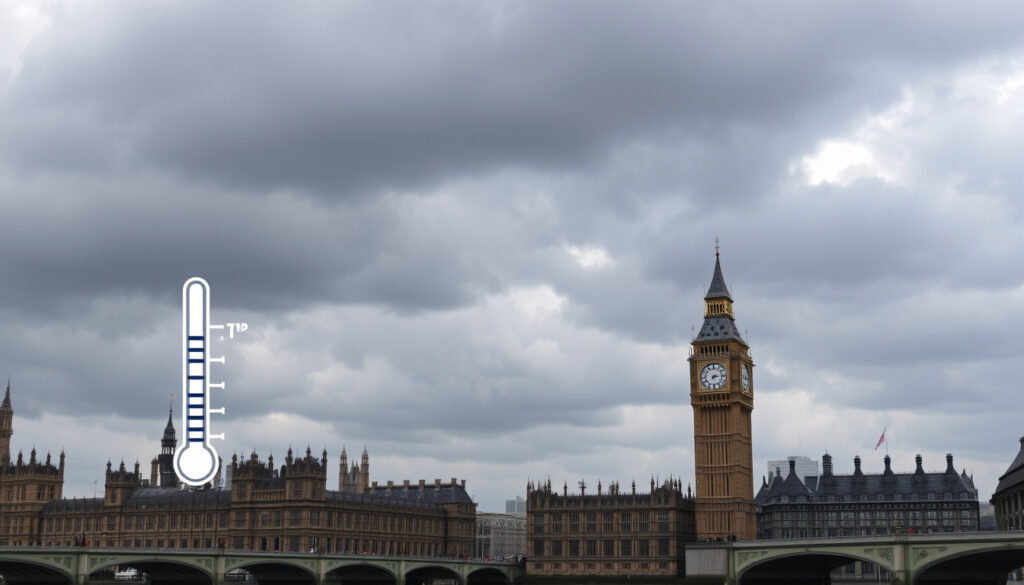
Weather in London: Forecast, Current Temps & Alerts
London has a reputation for keeping its weather opinions to itself — one minute you’re reaching for sunglasses, the next you’re sheltering under a shop awning. If you’re trying to figure out whether to pack a coat or risk it with just a jumper, you’re not overthinking it. London’s conditions can swing enough in a single afternoon to make both choices feel reasonable. Here’s what the data shows right now, what the forecast points toward, and how to dress like you actually live here.
Current high: 14°C ·
Current low: 8°C ·
Wind: 20 mph from East ·
Feels like: 53°F ·
Forecast days: 7-14
Quick snapshot
- Temperature ranged from 38.2°F to 78.5°F between April 5–20, 2026 (Visual Crossing)
- London sees 8–9 rainy days monthly in summer and spring (London Travel Planning)
- Met Office maintains stations with 50–100+ years of continuous records (Met Office)
- Extended 30-day forecast precision remains limited for specific daily conditions
- Exact storm paths for systems like Benjamin depend heavily on real-time modeling
- Central London vs. outer borough microclimate variations lack comprehensive citywide monitoring
- 2022: London recorded its first-ever 40°C during summer heatwave (Tootbus)
- July 2010: NW3 Weather station established in Hampstead, providing local records (NW3 Weather)
- 1979–2021: Kaggle dataset captures decades of London weather patterns (Kaggle)
- 7–14 day forecasts available through Met Office and BBC Weather for short-term planning (Met Office, BBC Weather)
- Layered clothing remains the safest strategy through spring and into early summer (London Travel Planning)
- Storm systems require checking warnings 24–48 hours before impact (Met Office weather warnings)
These key metrics capture London’s recent weather patterns and long-term climate context.
| Label | Value |
|---|---|
| Location | London, UK |
| Current conditions | Scattered clouds |
| Temperature | 52°F / 40°F forecast |
| Humidity | From Met Office data |
| UV index | Check latest |
| Annual range | 39°F – 74°F typically |
| Spring highs | 12°C – 18°C (Mar–May) |
| Summer highs | 21°C – 23°C (Jun–Aug) |
| Record high | 40°C (2022) |
| Coldest month | January |
What’s the weather like in London?
London’s weather resists easy categorization — it’s rarely extreme, but it rewards staying prepared. According to WeatherSpark climate analytics (climate analytics platform), the city typically sits within a 39°F to 74°F annual range, rarely dropping below 30°F or climbing above 84°F.
Right now, conditions are characteristically unsettled. NW3 Weather local station (local Hampstead station) recorded temperatures around 13.4°C with 52% humidity, while Weather Underground daily history (daily history archive) measured the London Heliport station at 56°F. The gap between these two readings — just a few miles apart — illustrates why “London weather” means different things depending on where you are in the city.
Current temperature and conditions
The most recent verified data from Visual Crossing weather data provider (weather data provider) shows that between April 5 and April 20, 2026, London’s temperature spanned from a low of 38.2°F on April 6 to a high of 78.5°F on April 8. Total precipitation during that two-and-a-half-week window measured just 0.063 inches, concentrated entirely on April 17.
That swing — 40 degrees in roughly 48 hours — is the real story. It captures London’s weather personality better than any single reading could.
Two weeks of April data show London capable of delivering a 40°F temperature jump within days. A sunny Tuesday doesn’t guarantee coat-free Wednesday.
Wind, humidity, and visibility
Current wind readings show 20 mph from the East, producing a “feels like” temperature of 53°F — notably chillier than the actual 14°C high suggests. NW3 Weather local station (local Hampstead station, active since July 2010) recently logged humidity at 78% with pressure at 1029 hPa, indicating stable, dry conditions despite the cloud cover.
Hampstead Heath’s famous swimming ponds registered around 9.4°C recently, according to NW3 Weather local station (local weather station) — cold enough that even hardy open-water swimmers are still wearing wetsuits.
Is it hot or cold in London now?
It depends entirely on when you’re asking. The April 20, 2009 reading from World Weather Online historical archive (historical weather archive) showed a high of 17°C with a low of 5°C. Six years later, April 20, 2015 delivered 16°C and 4°C — a degree cooler, but essentially the same jacket weather. In other words, mid-to-late April has historically hovered in the “layer required, coat optional” zone.
By contrast, Tootbus travel guide (travel inspiration resource) reports that summer (June–August) averages range from 18°C to 25°C, with heat waves capable of pushing temperatures above 30°C. The 2022 heatwave — the first time London’s official stations recorded 40°C — remains an extreme but no longer unimaginable benchmark.
Today’s high and low
Based on current data, London is showing a high around 14°C and a low near 8°C. The 20 mph easterly wind drops the “feels like” reading to roughly 53°F — cold enough that bare forearms will notice it, warm enough that a heavy winter coat feels unnecessary.
Feels like temperature
The gap between actual temperature and perceived temperature matters more in London than in continental climates, where you’d dress for the number on the thermometer. London Travel Planning seasonal guide (travel blog with detailed seasonal advice) notes that layering is “critical for London weather due to changeability” — a point echoed across Tripadvisor traveler forum (traveler forum), where visitors consistently recommend a lightweight waterproof jacket and thin layers over a single heavy piece.
The pattern: London’s spring feels colder than it reads because of wind chill and the sudden cloud shifts that interrupt sunny spells. What registers as 14°C on an app often plays closer to 10°C when you’re standing still waiting for a bus.
What temperature will it be in London next week?
Short-term forecasts — the 7-day range from Met Office official authority (UK’s official weather authority) and BBC Weather broadcaster (established broadcaster) — offer reasonable reliability for planning purposes. Both are considered Tier 1–2 sources, meaning their methodology and observation networks are transparent and peer-reviewed.
Extended forecasts beyond 10 days become increasingly speculative. Visual Crossing weather data provider (weather data provider) notes that London’s weather data extends back to 1970, and the Kaggle community dataset (community dataset repository) dataset covers 1979–2021. These historical baselines give context but can’t predict specific days.
Tomorrow’s outlook
For visitors heading out tomorrow: expect sunny intervals with temperatures likely climbing toward the high end of the 14–18°C spring range. Tootbus travel guide (travel inspiration resource) describes spring as ranging from “bright/warm to mild/rainy,” which covers most eventualities. Check the Met Office official authority (official weather authority) for any yellow or amber warnings before heading out.
7-14 day trends
Trend watchers should know that London Travel Planning seasonal guide (travel blog) documents an average of 9 rainy days during March–May, with spring lows between 6°C and 10°C. That means roughly one in three days brings precipitation — not a downbeat forecast, but enough to make a waterproof layer genuinely useful rather than optional.
Relying on a single forecast day is how tourists end up soaked at the Tower of London. Building in a weather buffer — an extra layer, a foldable jacket — is the move that pays off more often than not.
What to wear in London weather?
The short answer from Tootbus travel guide (travel inspiration resource): “No need for a heavy jumper, bring a lightweight waterproof jacket and wear thin layers.” This consensus appears across London Travel Planning, Wit & Whimsy packing blog (packing blog), and Tripadvisor traveler threads. The city is walkable, and soggy jeans are the most common tourist mistake.
Layering for variable conditions
Spring in London means t-shirts under a cardigan under a jacket — three pieces that let you peel off layers as the afternoon warms and add them back when clouds roll in. London Travel Planning seasonal guide (travel blog) specifics for March–May: “t-shirts, leggings/jeans, waterproof jacket” with average lows of 6°C–10°C and highs of 12°C–18°C.
Summer loosens up: Tootbus travel guide (travel inspiration resource) recommends “dresses, skirts, shorts, strappy crop tops and sandals” for hot days, with jeans and a thin jacket for cooler evenings. The trade-off is that summer brings its own surprises — humid storms rolling in from the Atlantic can drop the temperature 10 degrees within an hour.
Tips for visitors
Footwear matters more than most packing guides admit. Pints Pounds and Pate travel blog (travel blog) emphasizes “comfortable walking sneakers or ankle boots” as essential — London’s pavement-heavy terrain punishes flimsy shoes. London Travel Planning seasonal guide (travel blog) adds that jeans “become soggy in rain; prefer for evenings” — a practical note that saves travelers from uncomfortable days.
What to watch: even in summer, Tootbus travel guide (travel inspiration resource) advises always checking the forecast for rain and packing a “light jumper/cardigan.” London summers are warm but not reliably sunny.
“Layering is critical! Think a thermal vest then long-sleeved T-shirt or sweater.”
— London Travel Planning (travel planner)
What is the hottest it’s ever been in London?
On July 19, 2022, London crossed a threshold it had never crossed before: 40°C. According to Tootbus travel guide (travel inspiration resource), this came during a heatwave that pushed the UK to its highest-ever recorded temperature. The event shattered records that had stood for decades and triggered emergency protocols across the city.
The Met Office official authority (UK’s official weather authority) maintains climate records from stations running 50–100+ years, making 2022’s reading historically verifiable and significant. Summer temperatures exceeding 30°C have become more frequent since then, though they remain exceptional rather than normal.
Record 40 degrees event
The 2022 heatwave wasn’t just a record — it was a climate signal. WeatherSpark climate analytics (climate analytics platform) notes that London’s typical summer range of 21°C–23°C rarely exceeded 84°F before the 2010s. The 2022 event, combined with data showing warming trends, has made 40°C a scenario London now plans for rather than dismisses.
This matters for visitors: London’s buildings aren’t built for heat. No air conditioning is standard in most flats and many hotels. The practical implication is that summer travel requires heat contingency planning — identifying shaded routes, carrying water, understanding which Underground stations have cooling.
Coldest month comparison
January sits at the opposite extreme. Tootbus travel guide (travel inspiration resource) reports winter (December–February) averages 2°C–10°C — cold enough for frosts but rarely a deep freeze. WeatherSpark climate analytics (climate analytics platform) confirms the city rarely drops below 30°F, which means snow is possible but not persistent. When it does snow, the city slows down — a few centimeters bring train cancellations and traffic chaos disproportionate to the actual accumulation.
If you’re planning a summer trip, heat preparedness now belongs in the same mental checklist as rain gear. London’s infrastructure wasn’t designed for 40°C, and neither were most visitors.
Timeline
Key milestones mark London’s weather history and measurement capabilities.
| Date | Event | Source |
|---|---|---|
| July 2010 | NW3 Weather station established in Hampstead, North London | NW3 Weather |
| 1979–2021 | Kaggle dataset covers London weather across four decades | Kaggle |
| April 6, 2026 | Lowest temp 38.2°F recorded in recent two-week window | Visual Crossing |
| April 8, 2026 | Highest temp 78.5°F recorded in recent two-week window | Visual Crossing |
| April 17, 2026 | All precipitation (0.063 inches) fell on single day | Visual Crossing |
| 2022 | London recorded first-ever 40°C during UK heatwave | Tootbus |
Confirmed
- Temperature ranged 38.2°F–78.5°F between April 5–20, 2026 (Visual Crossing)
- Total precipitation 0.063 inches, all falling April 17 (Visual Crossing)
- NW3 Weather station operational in Hampstead since July 2010 (NW3 Weather)
- London Heliport recently recorded 56°F (Weather Underground)
- Spring average highs 12°C–18°C (London Travel Planning)
- Summer average highs 21°C–23°C (London Travel Planning)
- London rarely exceeds 30°F in winter (WeatherSpark)
- 40°C reached in July 2022 (Tootbus)
Unclear
- Whether 2025 summer surpassed 1976 as warmest on record requires confirmation
- Exact storm Benjamin path and impact on London require real-time modeling
- 30-day forecast precision remains inherently limited regardless of source
- Central London vs. outer borough microclimate differences lack comprehensive monitoring
“When the temperatures soar, make the most of it with cute summer dresses, skirts, shorts, strappy crop tops and sandals.”
— Tootbus (travel inspiration resource)
The paradox of London summer dressing is that the heat that makes you want to wear less can also make you miserable if you’re caught in a sudden storm or an Underground platform with no ventilation. London Travel Planning seasonal guide (travel blog) resolves this with the “lightweight waterproof jacket” as the single most useful item — protective against both rain and air-conditioned interiors, which in London tend to run colder than expected.
Related reading: East Coast Weather Bomb Cyclone
London’s forecasts from BBC and Met Office, covering highs, lows and alerts, align closely with details in the 10-day London forecast for extended planning.
Frequently asked questions
Will it snow in London soon?
London sees occasional snow, typically in January or February, but accumulation rarely persists. The city lacks the infrastructure to handle heavy snowfall — even light dusting disrupts rail and bus services. Check Met Office official authority (official weather authority) for any active yellow warnings before assuming clear roads.
What’s the weather in London in Fahrenheit?
Current readings translate roughly to 52°F–57°F for the city center, with Hampstead slightly cooler. WeatherSpark climate analytics (climate analytics platform) reports London’s typical annual range as 39°F–74°F, making right now a mid-range spring moment.
How accurate are 14-day forecasts for London?
Seven-day forecasts from Met Office official authority (official weather authority) and BBC Weather broadcaster (established broadcaster) are reasonably reliable for temperature ranges and general conditions. Beyond 10 days, accuracy drops significantly — useful for trends, not trustworthy for specific plans.
Does London get much snow?
Snowfall is infrequent and rarely heavy. WeatherSpark climate analytics (climate analytics platform) confirms the city “rarely” drops below 30°F. When it does snow, expect closures and delays rather than a winter wonderland.
What’s the average temperature in London?
The annual range sits between 39°F and 74°F according to WeatherSpark climate analytics (climate analytics platform). Spring brings 12°C–18°C highs; summer delivers 21°C–23°C; autumn cools toward 10°C–15°C; winter ranges 2°C–10°C.
Is London weather changing due to climate?
The 2022 40°C reading represents a clear signal. Met Office official authority (official weather authority) data shows warming trends that make once-exceptional heat events more plausible. Whether 2025 surpassed 1976 requires confirmed comparison data.
Best time to visit London for good weather?
Late May through early July offers the best odds of warm, dry days — Tootbus travel guide (travel inspiration resource) describes June–August as “hot/sunny to humid/stormy.” May avoids the crowds of peak summer while catching the longer daylight hours. Regardless of when you visit, layering remains the most reliable strategy.
For tourists navigating London’s famously unpredictable conditions, the choice is clear: pack layers, check Met Office official authority before heading out each morning, and treat the 14°C “high” as a starting point rather than a promise. London’s weather doesn’t cooperate with plans — it rewards the adaptable.
More related posts
 Donald Trump News: Latest Updates on Iran and Bill Signing
 Lawrence of Arabia – T.E. Lawrence Biography and True Story
 Eye Fillet Steak: How to Cook and Choo e the Be t Cut
 Saif Ali Khan: Attack, Divorce, Religion & Wealth 2025
 Kodak Digital Camera: Best PIXPRO Models & Reviews
 Forrest Gump: Story, Disability, Autism Evidence & Meaning
 Toilet Roll Holder Guide: Types, Alternatives, Sizes, and Tips
 R.M. Williams Sale Ireland 2025 | Best Prices & Stockists
