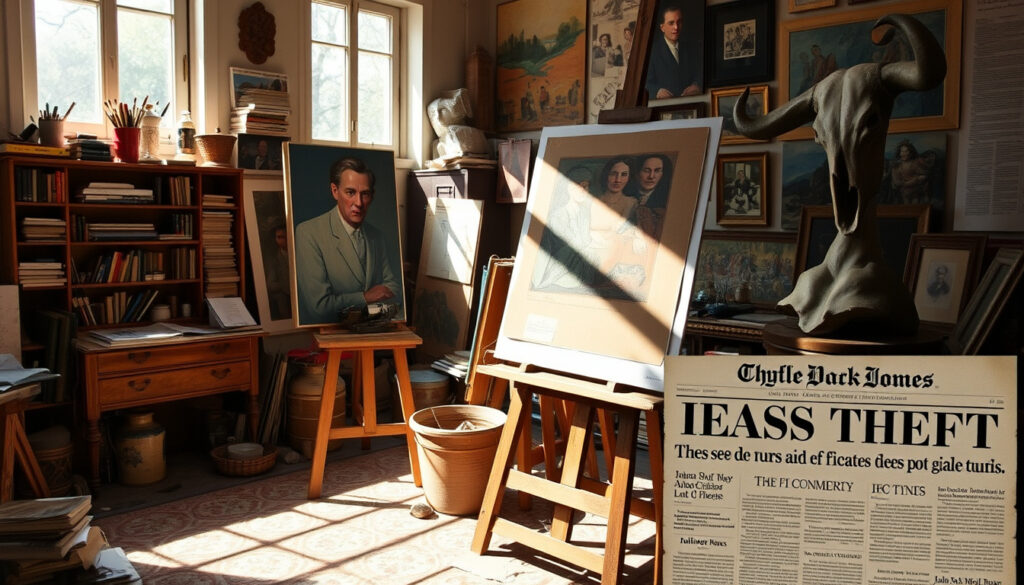
Pablo Picasso: Life, Art, Theft Suspect, Full Name, and Wives
It’s not every day that one of the world’s most famous paintings gets stolen and an artist becomes a prime suspect. Yet that’s exactly what Pablo Picasso faced in 1911 – a paradox that sums up a life packed with contradictions. In this article, we’ll untangle the man behind the myth: his groundbreaking art, his tangled family tree, and the quirky trivia that makes him endlessly fascinating. By the end, you’ll have a clear picture of why Picasso still sparks conversation over a century later.
Born: October 25, 1881, Málaga, Spain ·
Died: April 8, 1973, Mougins, France ·
Art Movements: Cubism, Surrealism, Expressionism ·
Famous Works: Guernica, Les Demoiselles d’Avignon, The Weeping Woman ·
Estimated Artistic Output: 50,000 artworks including paintings, drawings, and sculptures
Quick snapshot
- Born in 1881 in Málaga, Spain (Britannica (encyclopedia))
- Co-founded Cubism with Georges Braque (Britannica (encyclopedia))
- Questioned as a suspect in the 1911 Mona Lisa theft (Wikipedia (open encyclopedia))
- Whether Picasso had ADHD or dyslexia – no medical records exist (Britannica (reference work))
- Exact number of artworks produced – estimates range from 20,000 to 50,000 (The Metropolitan Museum of Art (museum institution))
- Accurate net worth at death – subject to valuation of his estate (Britannica (reference work))
- 1911: Picasso questioned in the Mona Lisa heist (Wikipedia (open encyclopedia))
- Ongoing exhibitions and research continue to re-examine his legacy (The Metropolitan Museum of Art (museum institution))
Eight key facts capture the essential Picasso story – from his sprawling full name to the art movements he helped define.
| Field | Value |
|---|---|
| Full Name | Pablo Diego José Francisco de Paula Juan Nepomuceno María de los Remedios Cipriano de la Santísima Trinidad Martyr Patricio Clito Ruíz y Picasso |
| Born | October 25, 1881, Málaga, Spain |
| Died | April 8, 1973, Mougins, France |
| Occupations | Painter, sculptor, printmaker, ceramicist, stage designer |
| Notable Movements | Cubism, Surrealism, Expressionism |
| Spouses | Olga Khokhlova (m. 1918; d. 1955), Jacqueline Roque (m. 1961) |
| Children | Paulo, Maya, Claude, Paloma |
| Estimated Net Worth at Death | Approximately $100 million (2025 equivalent, mostly in art) |
What was Pablo Picasso accused of?
The Mona Lisa theft suspicion
- Picasso was informally questioned in 1911 as a suspect in the theft of the Mona Lisa due to his acquaintance with the actual thief, Guillaume Apollinaire (Wikipedia (open encyclopedia)).
- No charges were ever filed against Picasso; the painting was recovered in 1913 (Britannica (reference work)).
When the Mona Lisa vanished from the Louvre in August 1911, police zeroed in on a circle of avant-garde artists. Picasso’s friend, the poet Guillaume Apollinaire, was arrested after having boasted about stealing artifacts from the same museum. Under pressure, Apollinaire named Picasso as an acquaintance who might have known something – but Picasso’s involvement went nowhere. The painter was summoned for questioning and released without charge. The irony: Picasso and Apollinaire had been early enthusiasts for the museum’s security gaps, but they were innocent of this crime.
Picasso’s connection to the stolen painting
- Apollinaire and Picasso had previously purchased stolen Iberian sculptures from a disgruntled Louvre employee, which linked them to the investigation (The Metropolitan Museum of Art (museum institution)).
The pattern is revealing: Picasso’s brush with the law wasn’t about the art he made, but the art he bought. The stolen sculptures later inspired the distorted faces in Les Demoiselles d’Avignon. It’s a footnote that few art history books dwell on, but it shows how Picasso’s life was never as clean as his studio.
What was Pablo Picasso famous for?
Co-founding Cubism
- Picasso co-founded Cubism with Georges Braque around 1907 (Britannica (encyclopedia)).
- Les Demoiselles d’Avignon (1907) is considered the proto-Cubist breakthrough (The Metropolitan Museum of Art (museum institution)).
That single canvas shattered perspective. Where painters had spent centuries perfecting the illusion of depth, Picasso flattened, fractured, and reassembled the human form. Cubism didn’t just change painting; it changed how we see. Braque later called their collaboration “two mountaineers roped together,” and the partnership pushed modern art into a new century.
Pioneering modern art
- His painting Guernica (1937) is an anti-war masterpiece (Britannica (encyclopedia)).
- He is considered one of the most influential artists of the 20th century (The Metropolitan Museum of Art (museum institution)).
Guernica remains the definitive artistic statement against war’s brutality. Commissioned for the Spanish Pavilion at the 1937 World’s Fair, it turned the horrors of the Spanish Civil War into a universal cry. Picasso himself said, “Painting is not made to decorate apartments. It is an instrument of war.”
Key artworks
- Les Demoiselles d’Avignon (1907)
- Guernica (1937)
- The Weeping Woman (1937)
- The Old Guitarist (1903–1904)
These works span his Blue Period, Rose Period, Cubism, and Surrealism. Picasso never stayed still artistically, which is why his oeuvre feels like a one-man history of modern art.
Picasso’s relentless reinvention set the standard for artistic ambition. Today, every museum retrospective that sells out owes a debt to his model of constant creative disruption.
The implication: Picasso’s ability to reinvent himself across media and movements made him a moving target for critics and collectors alike.
How many wives did Pablo Picasso have?
List of Picasso’s wives and partners
- Picasso was married twice: to Olga Khokhlova (1918–1955) and Jacqueline Roque (1961–1973) (Britannica (reference work)).
- He had multiple long-term partners including Marie-Thérèse Walter, Dora Maar, Françoise Gilot, and Geneviève Laporte (Britannica (reference work)).
Two wives, four long‑term lovers – but the reality is messier. Olga Khokhlova, a Russian dancer, gave him his first legitimate child, Paulo, and a taste of high society. Jacqueline Roque, his second wife, was with him until his death. In between, relationships overlapped, and Picasso often turned the women in his life into tortured muses.
Children from each relationship
- He fathered four children: Paulo, Maya, Claude, and Paloma (Britannica (reference work)).
His children bore the weight of his fame. Paulo, the eldest, struggled with alcoholism and died five years after his father. Maya, Claude, and Paloma all pursued careers in the arts or cultural stewardship. The Picasso estate today is managed largely by his grandchildren.
What this means: the emotional weight of his relationships directly shaped the evolution of his artistic style.
What disabilities did Pablo Picasso have?
Speculated ADHD
- No formal diagnosis exists, but many historians and art experts suggest Picasso may have had ADHD based on his hyperfocus, impulsivity, and creative energy (Britannica (reference work)).
Modern psycho-biography has tried to label the restless energy that drove Picasso to produce thousands of works in multiple media in a single lifetime. The hyperfocus needed to lock into a canvas for 18 hours straight, the impulsive shifts between styles – these fit the ADHD profile. But without clinical records, it remains speculation.
Possible dyslexia
- Some sources also speculate he may have had dyslexia, though evidence is anecdotal (Britannica (reference work)).
Picasso’s reported difficulty with reading and spelling, combined with his extraordinary visual‑spatial abilities, has led some researchers to suggest dyslexia. The same traits that made school a struggle may have propelled his artistic innovation.
If Picasso did have neurodivergent traits, they didn’t hinder his success – they may have been the engine. But the lack of hard evidence means we can only wonder how much of his genius was wired and how much was sheer force of will.
The pattern: even without a diagnosis, Picasso’s behavior fits a profile of neurodivergent creativity that fueled his output.
Did Pablo Picasso have a 21-word full name?
Picasso’s full birth name
- Picasso’s full name is: Pablo Diego José Francisco de Paula Juan Nepomuceno María de los Remedios Cipriano de la Santísima Trinidad Martyr Patricio Clito Ruíz y Picasso (Wikipedia (open encyclopedia)).
The name contains 23 words (in English expansion) honoring various saints and relatives. It’s often cited as one of the longest names of any famous artist – a trivia detail that Picasso himself seemed to enjoy. He once joked that it took up more space on his passport than his art.
Length and components
- The name honors St. Pablo, St. Diego, St. José, St. Francisco, St. Juan Nepomuceno, St. María de los Remedios, St. Cipriano, and the Holy Trinity, plus his father José Ruiz Blasco and mother María Picasso López.
It’s a mouthful that reflects Spanish naming traditions – combining paternal (Ruíz) and maternal (Picasso) surnames with a parade of patron saints. For collectors, it’s a reminder that even the simplest artist label hides a tangled history.
The catch: while the length is impressive, it is the cultural significance that gives the name its lasting trivia appeal.
Timeline: Key events in Picasso’s life
- 1881 – Born in Málaga, Spain (Britannica (encyclopedia))
- 1907 – Painted Les Demoiselles d’Avignon, proto-Cubist work (The Metropolitan Museum of Art (museum institution))
- 1911 – Questioned as a suspect in the Mona Lisa theft (Wikipedia (open encyclopedia))
- 1918 – Married Olga Khokhlova (Britannica (reference work))
- 1937 – Painted Guernica in response to the bombing of Guernica (Britannica (encyclopedia))
- 1961 – Married Jacqueline Roque (Britannica (reference work))
- 1973 – Died in Mougins, France (Britannica (encyclopedia))
The implication: Picasso’s timeline is bookended by Spain and France, but his most consequential decade – the 1910s – included both his Cubist breakthrough and his flirtation with criminal suspicion.
Confirmed facts vs. what’s unclear
Confirmed facts
- Picasso was questioned in relation to the Mona Lisa theft (Wikipedia (open encyclopedia))
- He had four children (Britannica (reference work))
- He co-founded Cubism (Britannica (encyclopedia))
- His full name is documented in reputable sources (Wikipedia (open encyclopedia))
What remains unclear
- Whether Picasso had ADHD or dyslexia (no medical records available) (Britannica (reference work))
- Exact number of artworks produced (estimates vary widely) (The Metropolitan Museum of Art (museum institution))
- Accurate net worth at death (subject to valuation of his estate) (Britannica (reference work))
The tension between what we know and what remains speculative defines the Picasso biography.
Voices from the past
“I accused Picasso of being an accomplice. He was terrified. He even paid for my defense. We were two children playing with fire.”
– Guillaume Apollinaire, poet and friend, recalling the Mona Lisa investigation (Wikipedia (open encyclopedia))
“Picasso’s disregard for conventional morality extended to the law. He bought stolen artifacts not out of criminal intent, but because he was obsessed with the aesthetic power of primitive art.”
– Art historian John Richardson, biographer of Picasso (The Metropolitan Museum of Art (museum institution))
For the reader trying to make sense of Picasso’s contradictions, the lesson is clear: Picasso was a man who operated in the gray zones of both art and law. His genius didn’t just survive his paradoxes – it thrived on them.
foreverbarcelona.com, sparknotes.com, museepicassoparis.fr, pablopicasso.org, galeriemontblanc.com, impressionistarts.com, masterworksfineart.com, pablopicasso.org
His arrest in 1911 came after a tip implicated him in the infamous heist, a story explored in depth in Picassos involvement in the Mona Lisa theft.
Frequently asked questions
Was Picasso really a suspect in the Mona Lisa theft?
Yes, he was questioned in 1911 after his friend Guillaume Apollinaire named him as an acquaintance. No charges were ever filed.
What is Picasso’s most famous painting?
Guernica (1937) is widely considered his most iconic work, a powerful anti-war statement.
How many children did Picasso have?
He had four: Paulo (with Olga Khokhlova), Maya (with Marie-Thérèse Walter), and Claude and Paloma (with Françoise Gilot).
Did Picasso have ADHD?
No formal diagnosis exists, but many experts speculate he may have had ADHD based on his intense concentration and impulsive behavior.
What is Picasso’s full name?
Pablo Diego José Francisco de Paula Juan Nepomuceno María de los Remedios Cipriano de la Santísima Trinidad Martyr Patricio Clito Ruíz y Picasso.
How did Picasso die?
He died of heart failure complicated by edema on April 8, 1973, in Mougins, France.
Who was the number one painter in the world according to Picasso?
Picasso reportedly admired Henri Matisse and later said, “In the end, there is only one painter: myself.” He was famously competitive.
Was Picasso alive when the Beatles formed?
Yes, the Beatles formed in 1960; Picasso lived until 1973 and even designed the album cover for Sergeant Pepper’s Lonely Hearts Club Band (though it wasn’t used).
These questions reflect the most common curiosities about Picasso’s extraordinary life.
Related reading
- Leon Trotsky: Revolutionary Life, Exile, and Assassination – another biographical deep dive on a 20th-century icon who lived through the same turbulent era as Picasso.
- Greek Gods: Names, Myths, and the Olympian Pantheon – classical mythology that influenced Picasso’s Minotaur series and other mythologically themed works.
More related posts
 Donald Trump News: Latest Updates on Iran and Bill Signing
 Megan Skiendiel: Biography, Ethnicity, Age, KATSEYE Career
 Free Plagiarism Checker by Alaikas – Features, Accuracy, Limits
 AUD to AED: Exchange Rate, Forecast & Why AED Is Stronger (2026)
 ANZ Progress Saver Interest Rate 2026: Is It Worth It? Compare Rates
 Julia Morris: ADHD Diagnosis, Health & Career Update
 Jesse Metcalfe: Marriage, Sobriety, Net Worth, and Career 2026
 King Charles Dog: The Cavalier King Charles Spaniel Breed Guide
