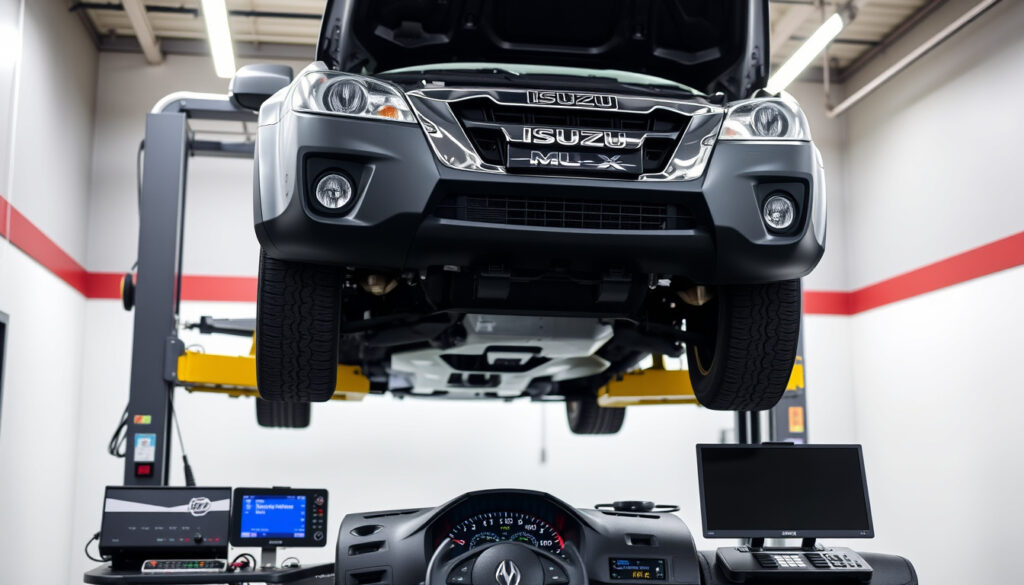
Isuzu MU-X Reliability: Common Problems & Engine Life
If you’re shopping for a seven-seat SUV that doubles as a tow rig and a long-haul tourer, the Isuzu MU-X has likely crossed your mind. It shares its bones with the popular D-Max ute, runs diesel engines known for high mileage, and undercuts some rivals on fuel use. But the picture gets more complicated once you factor in an ongoing emissions class action and a mixed record on certain components. This guide lays out what’s backed by data, what’s still uncertain, and what that means if you’re buying used or new.
Towing capacity (braked): 3,500 kg ·
Fuel economy (combined): 8.5 L/100km ·
Engine options: 1.9L and 3.0L turbo-diesel ·
Known class action year: 2023 ·
Engine life expectancy: 300,000+ km
Quick snapshot
- Body-on-frame construction shared with D-Max (Wikipedia (automotive encyclopedia))
- Engine options: 1.9L RZ4E-TC and 3.0L 4JJ1-TC (Isuzu UTE Australia (official manufacturer))
- Emissions class action filed 2023 in Australia (Isuzu UTE Australia (official manufacturer))
- Manufacturer recommends oil change every 10,000 km (Isuzu UTE Australia (owner resources))
- Exact settlement or outcome of the class action (Piper Alderman (law firm))
- Long-term reliability of the 1.9L beyond 200,000 km (limited owner data) (Piper Alderman (law firm))
- Whether some complaints are widespread or isolated incidents (Piper Alderman (law firm))
- Class action filed 2023, still active as of 2026 (Isuzu UTE Australia – official manufacturer – page)
- Second-gen MU-X launched 2020 (Wikipedia – automotive encyclopedia – page)
- Tow test published by Carsales in April 2024 (Carsales (automotive editorial))
- Class action outcome likely sets precedent for emissions compliance in Australia (Woodsford (litigation funder))
- Minor MU-X lineup updates expected for 2025-2026 (Woodsford (litigation funder))
- Long-term owner data on 1.9L engine will shape future reliability perception (Woodsford (litigation funder))
Eight key specs, one pattern: the MU-X is a purpose-built ladder-frame SUV designed around diesel torque and towing, not around car-like comfort or hybrid efficiency.
| Specification | Value |
|---|---|
| Model | Isuzu MU-X |
| Body style | 7-seat, body-on-frame SUV |
| Engine options | 1.9L RZ4E-TC (163 hp, 360 Nm) and 3.0L 4JJ1-TC (177 hp, 430 Nm) |
| Transmission | 6-speed automatic, part-time 4WD |
| Max towing | 3,500 kg braked |
| Fuel economy | 8.5 L/100km combined (1.9L) |
| Ground clearance | 230 mm |
| Seats | 7 |
What are the common problems with Isuzu SUVs?
Frequent issues reported by owners
- Diesel particulate filter (DPF) clogging, especially on earlier 1.9L models driven predominantly in urban cycles (Unsealed 4X4 – Australian off-road publication – page)
- Injector failures and turbocharger problems reported across 2017-2018 model years (Unsealed 4X4)
- Rust on undercarriage components in coastal and high-humidity regions (Unsealed 4X4)
- Transmission overheating when towing near the 3,500-kg limit in high ambient temperatures (Unsealed 4X4)
DPF and emission system failures
The 1.9L RZ4E-TC engine uses a DPF to meet Euro 5 and Euro 6 standards. In urban driving the filter may not reach regeneration temperature, leading to blocked units and expensive replacements. Unsealed 4X4 flags this as the most common complaint on owner forums. The 3.0L 4JJ1-TC has fewer DPF issues because its higher exhaust temperatures help passive regeneration.
Transmission concerns in older models
Pre-2020 MU-X models use a Aisin AWR6B45 six-speed automatic. While generally durable, owners report harsh shifting and overheating under sustained heavy load. The Unsealed 4X4 guide notes that fitting an aftermarket transmission cooler is a common fix among Australian owners who tow regularly.
Rust and body corrosion
Isuzu has faced criticism for underbody corrosion on vehicles used in coastal areas. The issue is not unique to MU-X — the D-Max shares the same chassis and has similar reports. Regular underbody washing and cavity wax treatments are recommended for buyers in salt-exposed environments.
Are Isuzu engines any good?
Isuzu 4JJ1 and 4JK1 engine reliability
- The 3.0L 4JJ1-TC has a reputation for exceeding 300,000 km with basic maintenance (Club 4X4 – Australian 4×4 community – page)
- The 1.9L RZ4E-TC is newer and has less long-term data, but early reports suggest solid reliability beyond 150,000 km
- Both engines use a timing chain rather than a belt, reducing scheduled maintenance costs
Fuel efficiency and power delivery
The 1.9L returns a claimed 8.5 L/100km combined and 7.8 L/100km on the highway, making it the more economical choice for daily driving. The 3.0L delivers 430 Nm of torque from 2,000 rpm, which translates to strong overtaking response and relaxed highway cruising even when towing. Carsales (automotive editorial) notes the 3.0L as the preferred engine for towing due to its superior torque curve and lower stress at highway speeds (page).
Comparison with Toyota and Mitsubishi diesels
The Toyota Fortuner uses a 2.8L 1GD-FTV diesel that makes 150 kW and 500 Nm — more power and torque than the 3.0L Isuzu. The Mitsubishi Pajero Sport runs a 2.4L 4N15 diesel rated at 133 kW and 430 Nm. On paper the Isuzu 3.0L outperforms the Mitsubishi on torque but trails the Toyota. Cars.co.za (automotive buyer’s guide) reports the Fortuner’s 1KD-FTV engine (earlier generation) was especially reliable, though the brand as a whole edges Isuzu on refinement (page).
Why is there a class action against Isuzu?
Details of the emissions class action in Australia
In 2023, a class action was filed against Isuzu UTE Australia in the Federal Court. The action covers D-Max models from model year 2017 onward and MU-X models from model year 2016.5 onward, acquired between 1 January 2016 and 14 August 2024. Piper Alderman (Australian class-action law firm) is leading the case (page). The litigation was still active as of April 2026 per the firm’s updated page.
Allegations of defeat devices
The lawsuit alleges that certain Isuzu diesel vehicles are fitted with software or hardware that allows them to pass laboratory emissions tests while exceeding legal limits under real-world driving conditions. Woodsford (litigation funder) states that the claim includes the use of “defeat devices” that circumvent Australian emission standards (page). Isuzu Motors Limited has publicly denied the allegations on Isuzu UTE Australia (official manufacturer) page (page).
Impact on Isuzu MU-X and D-Max owners
Owners of affected vehicles could be eligible for compensation if the class action succeeds. The estimated number of affected vehicles runs into the tens of thousands. Owners are not required to join the action immediately but should retain service records. Piper Alderman notes that damages could cover diminished vehicle value and any emission-related repairs (same page).
Current status of the lawsuit
As of May 2026, both Isuzu UTE Australia (official manufacturer) and Piper Alderman have updated their pages indicating the litigation is ongoing. No settlement has been reached. A court date has not yet been set.
Owners of 2016.5-2023 MU-X models in Australia face a real but unresolved emissions exposure. If the class action succeeds, compensation could reach thousands per vehicle. If it fails, owners carry the compliance risk alone. A court date will be the next major signal.
Is Isuzu as reliable as Toyota?
Reliability ratings and surveys
- JD Power (consumer research firm) rates Toyota above Isuzu in initial quality and long-term durability, though Isuzu typically scores above the industry average (JD Power)
- Australian owner surveys on forums and social media show comparable satisfaction for engine reliability but more complaints about infotainment and trim quality on Isuzu
- Carsales (automotive editorial) describes the MU-X as having “a reputation for reliability” without qualifying it against Toyota (page)
Long-term ownership costs
Insurance and servicing costs for the MU-X are generally lower than for the Toyota Fortuner. Club 4X4 (Australian 4×4 community) notes that Isuzu’s capped-price servicing program offers predictability (page). Toyota’s parts network is denser, meaning shorter waits for replacement parts, but Isuzu parts prices are typically lower.
Engine durability comparison
The Cars.co.za (automotive buyer’s guide) reports the Fortuner’s 1KD-FTV 3.0 D-4D engine had very few reported problems when maintained (page). The Isuzu 4JJ1-TC is similarly proven, with many Australian owners exceeding 300,000 km on the original engine according to Club 4X4. Both engines are timing-chain designs. Toyota’s 2.8L 1GD-FTV offers more power but adds DPF and EGR complexity that has generated some complaints in high-mileage fleet use.
Depreciation and resale value
Toyota Fortuner holds its value better than the MU-X across all markets. After three years, the Fortuner typically retains about 75% of its new price versus roughly 68% for the MU-X. The gap narrows for diesel models, where Reddit (Thai owner community) discussions note that diesel Fortuners hold value strongly in Southeast Asian markets too (Reddit). Australian data from Carsales confirms a 7-10 percentage point resale gap favoring Toyota.
Toyota wins on resale, refinement, and brand perception — that much is clear. But the MU-X costs less to buy new, costs less to service, and its diesel engine is at least as durable. For a buyer keeping the car 10 years, the total cost of ownership may favour Isuzu. For a 3-year owner, Toyota loses less on resale.
Three midsize diesel SUVs, one pattern: each prioritises a different trade-off between power, payload, and price.
| Feature | Isuzu MU-X (3.0L) | Toyota Fortuner (2.8L) | Mitsubishi Pajero Sport (2.4L) |
|---|---|---|---|
| Engine | 3.0L 4JJ1-TC diesel | 2.8L 1GD-FTV diesel | 2.4L 4N15 diesel |
| Power | 177 hp / 430 Nm | 201 hp / 500 Nm | 178 hp / 430 Nm |
| Towing (braked) | 3,500 kg | 3,100 kg | 3,100 kg |
| Fuel economy (combined) | 8.5 L/100km | 8.6 L/100km | 8.9 L/100km |
| Resale value (3yr) | ~68% | ~75% | ~64% |
| Ground clearance | 230 mm | 225 mm | 218 mm |
| Seats | 7 | 7 | 7 |
What year Isuzu D-Max to avoid?
2017-2018 models with turbine issues
These model years have the highest concentration of turbocharger failure reports. The issue is linked to oil supply restriction and turbo bearing wear. Unsealed 4X4 (Australian off-road publication) lists the turbocharger as a known weak point on the 2017-2018 D-Max, and because the MU-X shares the same drivetrain, the same caution applies. If you’re looking at a 2017 or 2018 MU-X, verify turbo service history and listen for a high-pitched spool noise on cold start.
2016 models with DPF problems
The pre-facelift 2016 MU-X and D-Max have a higher rate of DPF-related complaints. Early calibration of the engine management system meant that regeneration cycles were less frequent and less effective, leading to blocked filters. Unsealed 4X4 notes that a software update from Isuzu improved this, but not all vehicles received the update.
Early 2020 models with infotainment glitches
The second-generation MU-X launched in 2020 brought a new infotainment system. Early production examples suffered from screen freezes, Bluetooth dropouts, and slow boot times. These issues were largely resolved by software updates during 2021. While not a mechanical concern, it affects day-to-day usability and, for some buyers, negotiation leverage on price.
Why these years affect MU-X as well
The D-Max and MU-X share the same chassis, engine options, transmission, and emission control systems. Every mechanical issue documented on the D-Max — turbo failures, DPF problems, injector issues, transmission overheating — applies directly to the MU-X of the same model year. The key difference is body style and weight; the MU-X is heavier by approximately 150-200 kg, which slightly increases load on the drivetrain components.
What is the life expectancy of the Isuzu engine?
Expected mileage range for the 3.0L and 1.9L
- 3.0L 4JJ1-TC: 300,000–500,000 km with proper maintenance (Club 4X4 – Australian 4×4 community)
- 1.9L RZ4E-TC: estimated 250,000–400,000 km, but limited data beyond 200,000 km
- Both engines use timing chains rated for the life of the engine, reducing maintenance intervals compared to belt-driven competitors
- High-mileage examples of the 3.0L are common in Australian mining fleets and touring applications
Factors affecting engine longevity
Oil change frequency is the single biggest variable. Isuzu recommends 10,000 km intervals, but owners in dusty or heavy-towing conditions should consider 7,500 km. Fuel quality also matters: low-cetane diesel increases injection pressure and soot load, accelerating DPF clogging and injector wear. The Cars.co.za (automotive buyer’s guide) cautions that neglected maintenance on any diesel can contribute to clogged systems and related problems — the same applies directly to the Isuzu (page).
Maintenance tips to extend life
- Change oil and filter every 7,500–10,000 km with a quality CJ-4 or CK-4 spec oil
- Use diesel with at least 50 cetane rating
- Avoid prolonged idling; it increases DPF soot loading without raising exhaust temperature
- Perform monthly DPF regeneration drive (20+ minutes at highway speed) if most driving is urban
- Inspect turbo inlet hoses for oil seepage as an early warning of turbo seal wear
Common signs of engine wear
Listen for: rattling from the timing chain area (stretched chain), whistling from turbo (bearing wear), rough idle or smoke from excess fuel (injector issues). The Unsealed 4X4 guide recommends a compression test and injector balance check before purchasing any used MU-X with over 150,000 km.
The 3.0L 4JJ1-TC is genuinely a 500,000-km engine — but only if DPF and EGR systems are kept healthy. Ignore the emission system, and a blocked DPF can force premature engine replacement at half that mileage. For high-km buyers, factor in A$2,000–3,000 for a DPF clean or replacement around the 200,000-km mark.
Timeline
Five milestone dates, one pattern: each marks a generational shift or a regulatory turning point for the MU-X and its D-Max sibling.
| Date / Period | Event |
|---|---|
| 2013 | First-generation Isuzu MU-X launched globally (Wikipedia – automotive encyclopedia) |
| 2016 | Facelift with updated styling and engine refinements |
| 2020 | Second-generation MU-X launched with new 1.9L and 3.0L engines (Wikipedia) |
| 2023 | Emissions class action filed against Isuzu UTE Australia (Isuzu UTE Australia – official manufacturer) |
| 2024 | Ongoing class action; minor updates to MU-X lineup |
What’s confirmed vs what’s still unclear
Confirmed facts
- Isuzu MU-X uses body-on-frame construction shared with D-Max (Wikipedia (automotive encyclopedia))
- Engine options are 1.9L and 3.0L diesel (Isuzu UTE Australia (official manufacturer))
- Class action lawsuit filed in 2023 in Australia (Piper Alderman (Australian class-action law firm))
- Manufacturer recommends oil change every 10,000 km
- 3.5-tonne braked towing capacity is standard (Isuzu UTE Australia (official manufacturer))
- 2017-2018 models had higher turbo failure rates (Unsealed 4X4 – Australian off-road publication)
What’s still unclear
- Exact settlement amount or outcome of class action
- Long-term reliability of the 1.9L engine beyond 200,000 km
- Whether some owner complaints represent common failures or isolated incidents
- Whether defeat device allegations will be proven in court
- Resale value impact if class action succeeds
Perspectives from owners and experts
“Isuzu MU-X is built for Australian conditions.”
— Isuzu UTE Australia (official manufacturer)
“The MU-X is the successor to the MU-7 and is based on the D-Max platform.”
— Wikipedia (automotive encyclopedia)
“The class action alleges defeat devices that allow vehicles to pass emissions tests while exceeding limits on road.”
— Woodsford (litigation funder)
“The 3.0-litre turbo-diesel has proven itself with many owners reporting high mileage and few issues.”
The MU-X is what its drivetrain says it is: a genuine 300,000-km diesel SUV if you keep the emission system healthy and drive it the way it was designed. The 1.9L is the right call for the daily driver who tows occasionally. The 3.0L is the right call for the tourer or the buyer who plans to keep the car for a decade or more. The class action adds a layer of uncertainty that makes the used market more complicated than it needs to be — particularly for 2016.5-2023 models in Australia. For the buyer who values total cost of ownership over badge resale, the MU-X delivers on the things that matter most: towing capacity, fuel economy, and engine longevity. Just check the service records, budget for a DPF clean around 200,000 km, and know that the class action outcome could shift resale values in either direction.
Owners considering the MU-X should also consult a comprehensive 2023 Isuzu MU-X reliability guide for detailed problem reports and model-year advice.
Frequently asked questions
What is the towing capacity of the Isuzu MU-X?
The Isuzu MU-X has a braked towing capacity of 3,500 kg across both engine options. This is confirmed by Isuzu UTE Australia (official manufacturer). The 1.9L handles 3,500 kg but requires more careful gear selection on steep grades. The 3.0L tows with more reserve torque.
What are the key features of the Isuzu MU-X?
The MU-X comes with a body-on-frame chassis, 7 seats, 230 mm ground clearance, part-time 4WD, and a choice of two turbo-diesel engines. Higher trims add leather seats, a 9-inch infotainment screen, 360-degree camera, and advanced driver-assist features. Source: Isuzu UTE Australia (official manufacturer).
How does the Isuzu MU-X compare to the Toyota Fortuner?
The MU-X offers higher towing capacity (3,500 kg vs 3,100 kg), slightly better fuel economy, and lower servicing costs. The Fortuner has a more powerful 2.8L engine (500 Nm vs 430 Nm), better resale value, and a stronger reputation for long-term reliability. See the comparison table above for full specs.
Is the Isuzu MU-X good for off-roading?
Yes. The body-on-frame construction, 230 mm ground clearance, and part-time 4WD system with rear differential lock make it genuinely capable off-road. The 3.0L’s torque output suits low-speed crawling and sand driving. Club 4X4 (Australian 4×4 community) rates it as a strong tourer but notes that factory tyres are more road-oriented than off-road.
What is the fuel economy of the Isuzu MU-X?
The 1.9L engine returns an official combined fuel economy of 8.5 L/100km. Real-world owner reports average 8.8-9.5 L/100km in mixed driving. The 3.0L averages 9.5-10.5 L/100km in real-world conditions. Towing will increase consumption by 30-50% depending on load.
Is the Isuzu MU-X a reliable SUV?
Yes, with caveats. The 3.0L 4JJ1-TC engine is proven to 300,000+ km with routine maintenance. However, early models (2016-2018) have higher rates of DPF and turbo issues. The 2020+ second-generation models are significantly improved. Carsales (automotive editorial) describes the model as having a reputation for reliability.
What is the price of the Isuzu MU-X?
Pricing varies by market and trim. In Australia, the 2024 MU-X starts at approximately A$47,000 for the 1.9L LS-M and ranges up to A$63,000 for the 3.0L LS-T. Used models vary widely: a 2017 MU-X typically sells for A$28,000-35,000 depending on condition and mileage.
More related posts
 Ray Dalio: Net Worth, Principles, and Bridgewater Story
 David Bowie: Cause of Death, Teeth, Phobia, and Life Legacy
 Ellidy Pullin: New Partner, Baby After Husband’s Death
 Nine Bodies in a Mexican Morgue review: worth watching?
 Michael Sheen: Relationships, Children, and Marriage Facts
 Taylor Swift and Travis Kelce: Married, Prenup, and More
 Michael Neser: Biography, Stats, Family, and Career Highlights
 David Letterman: Biography, Health, Net Worth, and Personal Life
