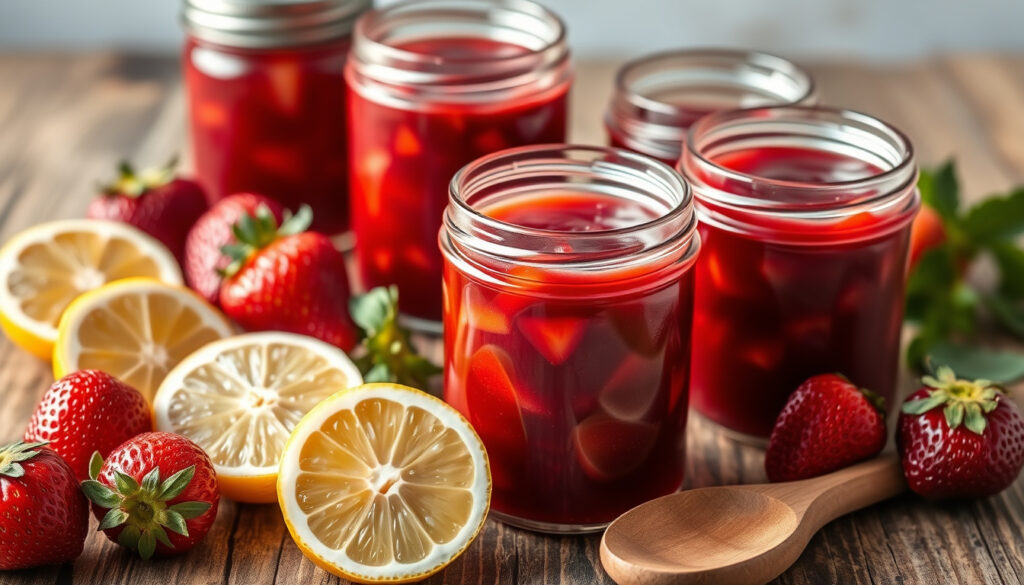
Strawberry Jam Recipe: Easy Mary Berry Guide
There’s something almost reckless about the amount of butter you slather on a scone when you know there’s homemade jam in the jar. This recipe cuts through the trickiest part of jam-making: the terror of opening a jar months later to find something closer to strawberry syrup than anything worth spreading.
Yield: 4-6 jars · Prep Time: 20 minutes · Cook Time: 10-15 minutes · Main Ingredients: 1kg strawberries, 750g jam sugar, lemon juice · Calories per tbsp: 45
Quick snapshot
- 3 ingredients, no added pectin (BBC Good Food)
- 20 min prep, 10–15 min cook (BBC Good Food)
- Overnight maceration, lemon zest (Mary Berry Cooks YouTube)
- Jam sugar with pectin for reliable set (Mary Berry Cooks YouTube)
- Faster cook (5–6 min rapid boil) (Mary Berry Cooks YouTube)
- Store-bought jam sugar does the work (Mary Berry Cooks YouTube)
- Natural flavor shines through (BBC Good Food)
- Longer boil required; lemon juice activates pectin naturally (BBC Good Food)
These figures represent the core parameters shared across Mary Berry’s method and BBC Good Food’s comparative recipe.
| Fact | Detail |
|---|---|
| Key Ingredient Ratio | 1kg strawberries to 750g sugar |
| Ideal Temperature | 105°C (221°F) |
| Shelf Life | 1 year unopened |
| Calories per 20g | 45 |
How to make a basic strawberry jam?
A basic strawberry jam needs only strawberries, sugar, and lemon juice. The trick is choosing slightly underripe berries — Mary Berry herself warns against overripe fruit because it simply will not give you a proper set (BBC YouTube Preview). Large strawberries get halved so the pieces fit properly on a scone without clumping.
Ingredients needed
- 1 kg hulled strawberries, slightly underripe preferred
- 750g jam sugar (pectin-added variety)
- Juice of 1 lemon
Step-by-step instructions
- Combine strawberries and lemon juice in a large heavy-bottomed pan over low heat.
- Let the fruit break down slowly, stirring occasionally — about 10 minutes.
- Add the jam sugar and stir continuously until fully dissolved.
- Turn heat to high and bring to a rapid boil for 5–6 minutes exactly (Mary Berry Cooks YouTube).
- Remove from heat and let rest for at least 10 minutes — this keeps fruit suspended evenly instead of sinking to the bottom (BBC YouTube Preview).
- Pot into sterilized jars while still hot.
Testing for set
The ripple test is your best friend here. Place a small dollop on a cold plate, refrigerate for 2 minutes, then push it gently with your finger (Mary Berry Cooks YouTube). If the edges wrinkle and the jam holds its shape rather than oozing back flat, you’re done. If it runs, return to a boil for another minute and test again.
How do you make Mary Berry strawberry jam?
Mary Berry’s version is the one most likely to appear on a British teatime table — and with good reason. It is built around jam sugar with added pectin, which transforms a historically temperamental process into something almost foolproof (Mary Berry Cooks YouTube). The method is worth following step by step because the resting period is what separates a well-distributed jam from a sad layer of jelly at the bottom with floating fruit on top.
Mary Berry’s ingredients and method
- 1 kg slightly underripe strawberries, hulled and halved if large
- 1 kg jam sugar with pectin
- Juice of 1 lemon, plus grated zest
Overnight maceration technique
Mary Berry layers the strawberries and sugar, then leaves them overnight to draw out the juices naturally — a step that BBC Good Food also recommends for a more intensely flavored result (BBC Good Food). By morning, the berries have released their liquid and the sugar has begun dissolving, meaning less cooking time and more fruit flavor preserved.
Key differences from basic
The overnight maceration is the main distinction. The pectin sugar handles the set while the long rest at the end of cooking keeps everything suspended. Mary Berry notes that when she was growing up, jam sugar with pectin did not exist — her mother had to add apples, gooseberries, or red currants to get jams to set (Mary Berry Cooks YouTube). Modern jam sugar removes that workaround entirely.
The pattern is clear: the more traditional methods traded convenience for reliability. Jam sugar with pectin guarantees a set in a way that adding high-pectin fruit never quite did.
Is strawberry jam better with or without pectin?
This is where home cooks and food writers disagree most sharply. The answer is not universal — it depends on whether you value flavor intensity or structural confidence (BBC Good Food).
Pros of pectin
- Pectin-added jam sugar delivers a reliable set every time — no guessing
- Shortens cooking time to 5–6 minutes, preserving fresh strawberry flavor
- Ideal for beginners or anyone canning for storage
Benefits of no pectin
- No added ingredients — just strawberries, sugar, lemon
- Result tastes more intensely of fresh fruit
- Traditional method with a deeper historical connection
When to choose each
Use pectin-added sugar if you need the jam to last a year unopened in the pantry. Skip it if you are making a smaller batch for the fridge and want the freshest possible flavor — and are willing to monitor the boil more carefully.
Pectin guarantees set but slightly masks the strawberry flavor. No-pectin jams taste brighter but require careful monitoring — overcooking destroys flavor, undercooking leaves you with syrup.
What do you put in strawberry jam to thicken it?
The primary thickener is pectin, whether added via jam sugar or activated naturally through cooking and acidity. Lemon juice plays a dual role: it adds brightness and activates the pectin already present in underripe strawberries (BBC YouTube Preview). A single lemon is standard in most recipes, though some home cooks report that two lemons produce a firmer set — particularly with very fruity batches.
Pectin options
- Jam sugar with added pectin: the simplest route — sugar and gelling agent in one
- Commercial liquid or powdered pectin: added separately, allows control over sweetness
- Natural pectin from underripe fruit: works if strawberries are firm enough, but less predictable
Lemon juice role
Lemon juice lowers pH and creates the acidic environment pectin needs to gel properly. Without it, even a full-pectin jam can stay loose. One lemon is the baseline; two is the workaround when your fruit is particularly sweet or watery.
Sugar ratios
Standard ratio is roughly 750g sugar to 1kg strawberries — about 60% of the fruit weight. Lower sugar means thinner jam that spoils faster. If you want to reduce sugar, you will need to add commercial pectin formulated for reduced-sugar recipes.
What are the common mistakes in making jams?
Five mistakes account for nearly every failed jam batch. They are predictable enough that once you know them, you can check for each one automatically.
Overcooking issues
Boiling jam past the set point destroys the pectin structure and gives you a stiff, dark mass that no amount of spreading helps. The fix is simple: use the ripple test before pulling the pot off the heat. Once wrinkles form, you are done — any further boiling is pure loss.
Undercooking fixes
Runny jam is almost always undercooked. The solution is a brief re-boil: return the pot to heat, bring to a hard boil for 2–3 minutes, and test again with the ripple test. Some home cooks report needing to repeat this twice to get a reluctant batch to set.
Sterilization errors
Using dirty jars is the fastest way to lose a year’s worth of jam to mold. BBC Good Food recommends sterilizing jars in a low oven (120°C for 20 minutes) or running them through a hot dishwasher cycle (BBC Good Food). Jars should be hot when you pour in the hot jam — temperature shock between jar and jam can cause cracking and contamination.
One user on BBC Good Food reported getting perfect flavor but a runny consistency and recommended adding the juice of 2 lemons instead of 1 — a simple adjustment that activates more natural pectin and tightens the set.
What checks out
- Jam sets at 105°C per multiple sources (Mary Berry Cooks YouTube)
- Ripple test (2 minutes on cold plate) confirms readiness
- 10-minute rest prevents fruit separation
- Unopened jam keeps 1 year when properly sterilized
- Underripe strawberries contain more natural pectin
What needs more data
- Exact best pectin brand varies by region and availability
- User reports on two-lemon modification are anecdotal, not tested
- Optimal sugar reduction level for shelf stability is debated
How to store homemade strawberry jam?
Storage is straightforward when you follow one rule: keep unopened jars sealed and cool. Once opened, everything moves to the refrigerator where homemade jam typically lasts 2–3 weeks. Unopened and properly sealed, the jam holds for up to 1 year according to Mary Berry’s method (Mary Berry Cooks YouTube).
Freezing is possible but not ideal for long-term storage. The texture changes noticeably after thawing, so most home preservers stick with the pantry method and work through their supply over winter.
“You don’t want the strawberries too ripe because you won’t get a good set. It’s best to have them slightly underripe.”
— Mary Berry, Chef (BBC YouTube Preview)
“When I was a little girl there wasn’t such a thing as Jam sugar and Mum used to have difficulty in getting these jams a set.”
— Mary Berry, Chef (Mary Berry Cooks YouTube)
“I got 5 lovely jars of jam — tastes great if a bit runny. Next time I would add at least the juice of 2 lemons instead of 1.”
— Recipe Tester (BBC Good Food)
Mary Berry’s approach makes the case for pectin-added jam sugar as a genuine simplification rather than a compromise. Her method produces five to six jars of jam with near-guaranteed set, minimal risk of fruit separation, and a shelf life that outlasts most people’s New Year’s resolutions to eat through their preserves. The BBC and Mary Berry both back the ripple test as the most reliable home indicator — more trustworthy than temperature for most home kitchens. For the home cook, the choice between pectin and no-pectin comes down to priorities: batch-and-forget reliability with jam sugar, or brightness and tradition without it.
Related reading: Aldi Cocolicious Chocolate Water Taste Test · Brown Brothers Moscato Tasting Notes and Pairings
Mary Berry enthusiasts will appreciate how this jam elevates Mary Berry’s Victoria sponge, the quintessential British cake layered with cream for afternoon tea.
Frequently asked questions
How long does homemade strawberry jam last?
Unopened and properly sealed, homemade strawberry jam keeps for up to 1 year in a cool, dark cupboard. Once opened, store it in the refrigerator and use within 2–3 weeks.
Can I reduce sugar in strawberry jam recipe?
Standard jam recipes require roughly 60% sugar by fruit weight for shelf stability. Reducing sugar is possible but requires commercial low-sugar or no-sugar pectin, and the resulting jam must be refrigerated and consumed more quickly.
Do I need to hull strawberries for jam?
Yes. The green calyx and any white core left on the strawberry affect flavor and texture. Hulling is standard practice in every recipe from BBC Good Food to Mary Berry’s method.
How to sterilize jars for jam?
Bake clean jars in a preheated oven at 120°C for at least 20 minutes, or run them through a hot dishwasher cycle. Jars must be hot when you pour in the hot jam to prevent cracking.
What if my strawberry jam doesn’t set?
Runny jam is almost always undercooked. Return it to a hard boil for 2–3 minutes, then repeat the ripple test. Some batches require two rounds. Adding extra lemon juice can also help activate pectin for a firmer set.
Can you freeze strawberry jam?
Yes, but the texture changes noticeably after thawing — the jam becomes looser and the fruit more granular. Freezing works best if you plan to use the jam in cooking rather than spreading.
Is lemon juice necessary in strawberry jam?
Technically optional in small amounts, but practically essential. Lemon juice activates pectin for proper gelling and adds brightness to the flavor. Most recipes call for the juice of one lemon minimum.
More related posts
 Joan Crawford Biography: Career, Death & Bette Davis Feud
 Matt Moran: Biography of the Chef and Farmer
 Forrest Gump: Story, Disability, Autism Evidence & Meaning
 Dean Withers: Liberal Political Commentator and TikTok Streamer
 Jofra Archer Injury 2025: Speed, Net Worth & Personal Life
 Cha Eunwoo: Tax Controversy, ASTRO Updates & Facts
 Andrew Bogut: NBA Career, Rings, Retirement, and What He Does Now
 Reggie Kray: Life, Crimes, and Notorious Legacy
