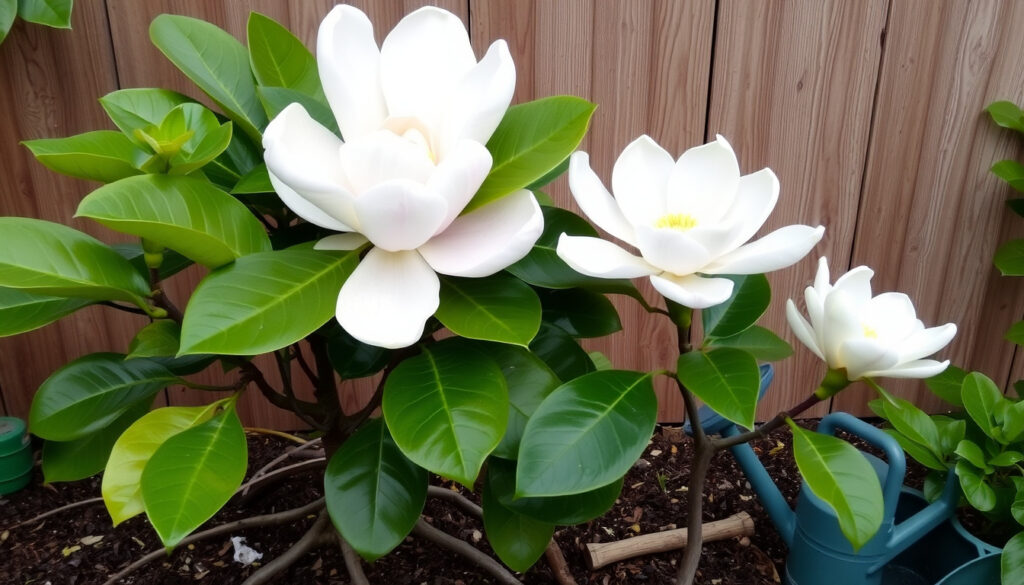
Teddy Bear Magnolia Size, Care & Little Gem Comparison
Anyone who has tried to pin down the Teddy Bear Magnolia’s size has met a different number on every nursery page. The useful starting point is Benara Nurseries, a commercial plant grower, which lists the tree at about 3 m tall and 1.8 m wide — a genuinely small, low-pruning magnolia for tight gardens, once you know which claims to trust.
Mature height: 4 m (13 ft) ·
Growth rate: Slow to moderate ·
Flower period: Summer to Autumn ·
Habit: Compact, cone-shaped ·
Flower color: Creamy white ·
Hardiness zones: 7–9 (USDA)
Quick snapshot
- Evergreen southern magnolia cultivar with a compact, upright to pyramidal habit (Magnolia King Australia, specialist magnolia nursery)
- Dark, glossy evergreen foliage held year-round (Homes To Love Australia, homes and gardens site)
- Final garden size: listings range from about 3–4 m up to 6 m tall (Four Seasons Nursery, Australian plant retailer)
- Long-term lifespan and disease resistance in Australian conditions are not documented in the sources reviewed (Four Seasons Nursery)
- Some sellers describe plants reaching up to 4 m × 2 m in roughly 10 years (Ross Evans Garden Centre, Australian garden centre)
- Deep watering twice a week in year one, weekly in warm weather in year two, settles the root system (Nursery Near Me, plant retailer)
- Choose a bright, well-drained position first and the tree does most of the rest (Nursery Near Me)
Seven specs, one pattern: Benara Nurseries lists the tree at about 3 m by 1.8 m, other Australian sellers stretch that to as much as 4 m, and every number points to a genuinely compact magnolia.
| Spec | Detail |
|---|---|
| Botanical name | Magnolia grandiflora ‘Teddy Bear’ |
| Common name | Teddy Bear Magnolia |
| Mature height | 4 m (13 ft) |
| Mature spread | 2–3 m (6–10 ft) |
| Growth rate | Slow to moderate |
| Flower color | Creamy white |
| Hardiness zones | 7–9 (USDA) |
What this means: Better Homes & Gardens Australia puts the standard southern magnolia at about 10 m tall and 15 m wide, and every figure above sits far below it — “compact” is earned, not marketing.
How big do Teddy Bear Magnolia trees get?
The shortest honest answer is 3–4 m tall by 1.8–3 m wide, depending on the listing. Four Seasons Nursery, an Australian plant retailer, gives the full range; Benara Nurseries, a commercial grower, settles closer to 3 m by 1.8 m.
The outlier is Magnolia King Australia, a specialist magnolia nursery, which lists an average height of 6 m and a width of 1–1.5 m. The Tree Shop Nursery Melbourne says that taller figure is an upper, site-dependent estimate rather than the size to plan around.
None of these sources is lying — they are describing the same cultivar in different soils. Plant for 4 m and you will be comfortable with every mainstream listing.
The pattern: the Teddy Bear’s “size problem” is really a listing problem. The tree itself is consistently the smallest evergreen grandiflora you can buy in Australia.
Is Magnolia Teddy Bear fast growing?
No — and that is a feature. The growth rate is slow to moderate, which is exactly what you want from a courtyard or boundary tree. The timeline signal above is the best guide: up to 4 m by 2 m over roughly a decade keeps pruning duties light.
Flowering is the seasonal reward: creamy white blooms arrive in summer and autumn, and fuller growth and flowering track with higher light levels.
A tree that takes roughly a decade to reach 4 m is a tree you plant once and enjoy for decades. Slow growth is the feature, not the bug.
What’s the difference between a Teddy Bear Magnolia and a little gem magnolia?
Both are evergreen Magnolia grandiflora cultivars bred for tighter spaces. The Teddy Bear is the compact one of the pair — slower growing and smaller at maturity — while Little Gem is the taller cultivar, commonly listed at 6–8 m.
If your site has about 4 m of vertical clearance, the Teddy Bear is the safer fit. The Tree Shop Nursery Melbourne reads the taller figures as upper estimates, and that reading matches how compact this tree stays in practice.
Two cultivars sold under the same “compact” promise can end up 2–4 m apart in mature height. The label is only useful if you check the fine print.
Three size classes, one pattern: the standard grandiflora needs serious space, Little Gem needs a medium garden, and the Teddy Bear fits the tight spots — Better Homes & Gardens Australia puts the full-size form at about 10 m by 15 m, which is the scale everything below is working from.
| Metric | Teddy Bear Magnolia | Little Gem | Standard M. grandiflora |
|---|---|---|---|
| Mature height | 3–4 m | 6–8 m | about 10 m |
| Mature spread | 1.8–3 m | More height than Teddy Bear | up to 15 m |
| Evergreen foliage | Yes — dark and glossy | Yes | Yes |
| Garden fit | Small gardens and screening | Medium gardens | Large open spaces |
If you are planning the courtyard layout around the tree, the Seat Bench Guide rounds up storage-friendly outdoor benches.
The trade-off: Little Gem gives you more height and a quicker screen; Teddy Bear gives you a tree that stays where you planted it.
What are the downsides of Magnolia trees?
The Teddy Bear has the same weaknesses as other magnolias, scaled down. It is shallow-rooting and surface-spreading, which matters in tight beds, and Ross Evans Garden Centre warns that prolonged standing water increases root problems in exactly this type of root system.
The second drawback is litter. The tree is evergreen, so it drops old leaves through the year rather than in one autumn event — the glossy foliage that makes it handsome is the same foliage you will be sweeping, and young trees stay sensitive to dry spells until the roots establish (Homes To Love Australia, homes and gardens site).
Wet feet, not dry soil, are the fastest way to lose a young Teddy Bear. Set up drainage before you set the tree.
The catch: this is a tidy tree, not a no-work tree — year-round leaves, shallow roots, and a first two years that need supervision.
Where is the best place to plant a magnolia tree?
Position comes first. Magnolia King Australia, a specialist magnolia nursery, puts it plainly: the cultivar performs best in full sun to part shade, with fuller growth and better flowering at the brighter end of the range.
Soil comes second. One Australian nursery guide recommends slightly acidic loam around pH 5.5–6.5, and Nursery Near Me adds that heavy clay or poorly drained sites should be improved or planted as raised beds before the tree goes in.
Drainage and sunlight decide nearly everything; watering is the follow-through.
Water is the establishment variable. Homes To Love Australia, an Australian homes and gardens site, advises regular deep watering during hot, dry periods, while Nursery Near Me gets specific: deep watering twice a week in the first summer, weekly in warm weather in year two. For the wider watering and light-troubleshooting routine, the Happy Plant Care guide covers the basics.
Twelve specs, one pattern: position and drainage decide nearly everything else on this list.
| Spec | Detail |
|---|---|
| Botanical name | Magnolia grandiflora ‘Teddy Bear’ |
| Plant type | Evergreen tree |
| Habit | Compact, upright to pyramidal |
| Mature height | 3–4 m typical; one listing up to 6 m |
| Mature spread | 1.8–3 m |
| Growth rate | Slow to moderate |
| Foliage | Dark, glossy, held year-round |
| Flower color | Creamy white |
| Flower period | Summer to autumn |
| Position | Full sun to part shade |
| Soil | Well-drained, slightly acidic (pH 5.5–6.5) |
| Hardiness zones | 7–9 (USDA) |
Why this matters: every care decision on this list follows from the same two inputs — light and drainage — and the Teddy Bear asks for very little else.
Every compact tree comes with a trade list. Here is the honest one for the Teddy Bear.
Upsides
- Compact in most Australian listings — mostly 3–4 m tall, with a spread well under 3 m in many gardens.
- Evergreen, dark glossy foliage gives structure in every season.
- More compact than standard southern magnolias, so it works in small gardens and screening rows.
- Comparatively drought tolerant once established.
- Slow growth means minimal pruning demands.
Downsides
- Slow to moderate growth — not an instant screen.
- Young trees need consistent deep watering through the first two summers.
- Surface roots can invade tight beds and lift mulch.
- Evergreen leaves drop all year, not just in autumn.
- Nursery listings disagree on final size, so planning is harder than it should be.
The implication: the Teddy Bear Magnolia rewards patience and good drainage, but the upfront research on planting position saves years of corrective pruning.
Confirmed facts
- Most Australian listings put the Teddy Bear at 3–4 m tall (Four Seasons Nursery)
- The taller 6 m figure is an upper, site-dependent estimate, not the norm (The Tree Shop Nursery Melbourne)
- Prolonged standing water increases root problems, so well-drained soil is essential (Ross Evans Garden Centre)
What’s unclear
- Final height in a specific garden: anywhere from 3–4 m to the 6 m outlier, depending on soil and climate.
- Long-term lifespan under Australian garden conditions — no lifespan data appears in the listings reviewed.
- Long-term disease resistance — not documented by the sources reviewed.
- Performance on heavy clay without soil improvement — site-dependent.
What the nurseries say
“An evergreen, upright growing magnolia reaching 4m.”
— Blerick Tree Farm, tree nursery
“Compact and naturally neat cone shaped habit.”
— The Tutu Guru, plant product guide
Gardeners who buy a Teddy Bear Magnolia expecting a small tree get exactly that, as long as they read the 3–4 m listings rather than the 6 m outlier. For the Australian small-space gardener, the decision is clear: pick the Teddy Bear when a compact evergreen with minimal pruning is the goal, or plant a Little Gem and budget for the extra height it will want in a decade.
Frequently asked questions
What is the most beautiful magnolia tree?
Beauty is subjective, but the Teddy Bear is a strong candidate for small gardens: creamy white summer-to-autumn flowers against dark evergreen foliage, on a tree that stays under 4 m.
Can Magnolia grandiflora be found in Australia?
Yes. It is widely stocked by Australian nurseries including Magnolia King, Benara Nurseries, Four Seasons Nursery, and Ross Evans Garden Centre, and it suits most southern climate zones.
What is the lifespan of a magnolia tree?
Precise lifespan figures for the Teddy Bear cultivar are not published in the Australian listings reviewed. Magnolias are generally considered long-lived, but this cultivar’s exact garden lifespan is undocumented.
Are magnolia roots invasive?
Magnolia roots are surface-rooting, so in tight beds they can invade nearby planting and lift mulch. They are a genuine design consideration in small gardens.
Are magnolia roots deep or shallow?
Shallow and spreading rather than deep, which is why surface competition with neighbouring plants is the main issue.
Can you keep a dwarf magnolia small?
The Teddy Bear keeps itself small — that is the cultivar’s purpose. Minimal pruning is required because the growth rate is naturally slow to moderate.
Can magnolias be cut back hard?
Hard pruning is risky for a slow-growing evergreen like the Teddy Bear. Because recovery is slow, a severe cut can leave a hole in the garden for years. Choosing the right size tree from the start is the better answer.
More related posts
 Taylor Frankie Paul: Swinging Scandal, LDS Exit & New Life
 Jane Remover: Gender Identity, Music, and Real Name Explained
 FIFA World Cup Asian Qualifiers Games: Tables & Schedules
 Gary Oldman: Life, Controversies, and Oscar-Winning Career
 Desmond Bane Trade: Analysis, Salary, and Career Stats
 Ray Dalio: Net Worth, Principles, and Bridgewater Story
 Chester Bennington Death: Cause, Family feud & Legacy
 Bryan Kohberger: Evidence, Alibi, and Timeline of Idaho Murders
